Updated April, 2026
Small financial decisions today can turn into meaningful results over time. If you’re wondering how to start investing, the barrier to entry has never been lower. You do not need a large salary, advanced knowledge, or thousands of dollars to begin.
Today, many investors start with as little as $100. What matters most is not how much you invest at the beginning, but whether you build a consistent habit and choose investments that align with your goals. This guide walks through how to start investing, what to invest in, and how platforms like Groundfloor can fit into any portfolio.
Why Starting Investing Early Still Matters
Time is one of the most powerful advantages an investor has. The earlier you start, the more time your money has to grow through compounding. Compounding means your returns generate additional returns. Over time, this creates a snowball effect where even small, consistent contributions can grow into significant amounts.
Starting early gives you flexibility. Starting later simply means you may need to invest more consistently or allocate more aggressively. Either way, the most important step is getting started.
How Much Money Do You Need to Start Investing?
A common misconception is that investing requires a large upfront commitment. In reality, many modern platforms have removed that barrier. However, it’s important to recognize that solely investing a low amount, like $50-$100, will not produce exciting returns without consistent addition of more capital.
Today, you can:
- Open accounts with no minimum balance
- Buy fractional shares of stocks and ETFs
- Start investing with as little as $50 to $100
Groundfloor follows this same philosophy. Many of its investments, including Notes, allow you to start with $100, making private market investing accessible to first-time investors. The key takeaway is simple. Start with what you can. Consistency matters far more than the initial amount.
Start With Your Investing Goals and Timeline
Before choosing investments, define your goal. This determines your risk level, strategy, and investment choices.
Short-term (0 to 3 years)
Examples include emergency savings, travel, or a major purchase
Focus on stability and liquidity
Mid-term (3 to 10 years)
Examples include a home down payment or starting a business
Balance growth with risk
Long-term (10+ years)
Examples include retirement or building long-term wealth
Focus on growth-oriented investments
Your timeline should guide every investment decision you make.
Understanding the Main Types of Investments
Typically, the strongest and highest-performing portfolios are built using a mix of core asset classes:
Stocks
Stocks represent ownership in companies. They offer strong long-term growth potential but can fluctuate significantly in the short term.
Bonds
Bonds are loans to governments or companies that typically provide steady, predictable income. They are generally less volatile than stocks.
Real Estate (Including Real Estate Debt)
Real estate is one of the most widely used alternative investments. While many people think of buying property, another option is investing in real estate-backed loans.
Groundfloor specializes in this type of investing. Instead of owning property, investors fund short-term real estate loans and earn returns based on the interest paid. This provides exposure to real estate without the responsibilities of ownership.
Real estate is one type of private market investment, a category that includes assets outside of public stock and bond markets. Historically, private markets were mostly limited to institutions and high-net-worth investors, but they are now becoming more accessible to everyday investors. Private markets have expanded rapidly in recent years, growing to around $22 trillion globally. This reflects a shift as more investors look beyond traditional stocks and bonds for diversification, income, and access to real asset-backed opportunities.
This is where Groundfloor fits into a modern portfolio. It bridges the gap between traditional fixed income and real estate investing by offering investments backed by real assets.
Choosing Investments Based on Your Timeline
Your timeline determines how much risk you can take.
Short-Term Investing
If you need your money soon, stability is the priority.
Common options include:
- High-yield savings accounts
- Money market funds
- Short-term bonds
- Real estate-backed Notes with defined terms
Groundfloor Notes are often positioned as a fixed income alternative. They offer defined durations and target returns, making them a potential option for investors looking for predictable income with relatively short commitments.
Mid- to Long-Term Investing
If you have several years or more, you can take on more risk for growth.
Common options include:
- Stock index funds
- Retirement accounts like 401(k)s or IRAs
- Diversified real estate investments
Some investors use Groundfloor alongside traditional investments to diversify into private markets. This adds exposure beyond public stocks and bonds while maintaining a passive structure.
Active vs. Passive Investing
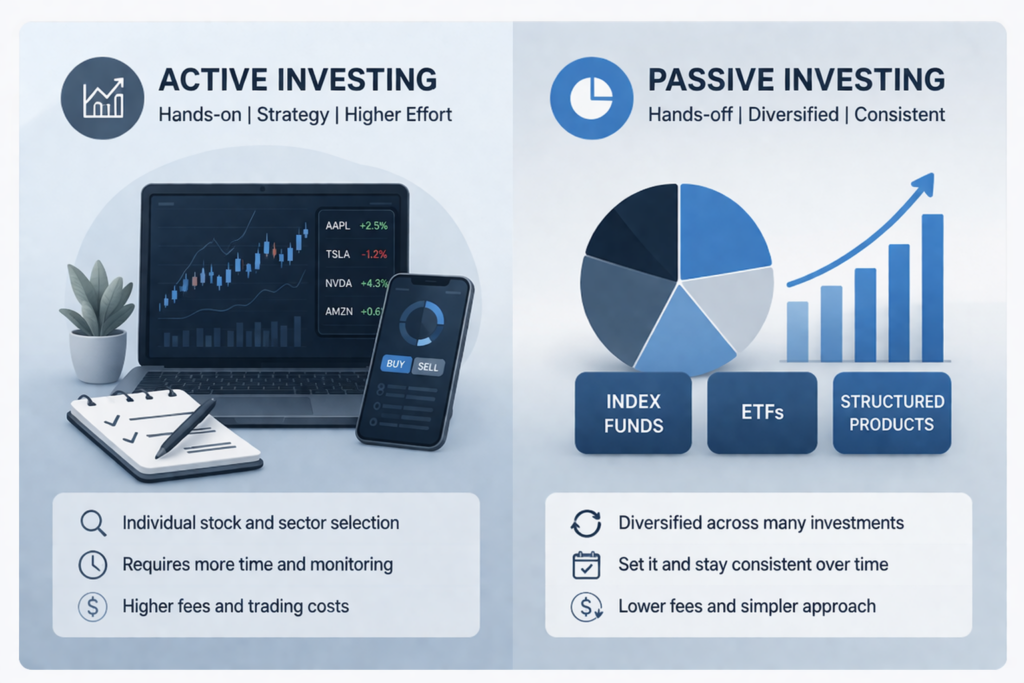
Active Investing
This involves selecting individual investments and trying to outperform the market. It typically requires more time and carries higher costs.
Passive Investing
This approach focuses on consistency and diversification. Examples include index funds or structured investment products.
Groundfloor investments are designed to be passive. Investors select opportunities, but the platform handles underwriting, servicing, and repayment. This makes it easier for beginners to access real estate-backed investing without managing properties or sourcing deals themselves.
Where Groundfloor Fits in a Beginner’s Investment Portfolio
Groundfloor sits at the intersection of three major investment themes: Fixed income alternatives, real estate investing, and private market access. The same product can serve different investor needs depending on their goal. For example:
- A conservative investor may view Notes as an alternative to CDs or high-yield savings
- A real estate investor may use Notes as an entry point into property-backed investments
- A diversified investor may use Groundfloor to add private market exposure alongside stocks and bonds
This flexibility makes it especially useful for beginners who want to start small while exploring different strategies.
Common Mistakes to Avoid When Starting to Invest
Many investing mistakes are behavioral rather than technical. A consistent, disciplined approach typically produces better long-term outcomes.
- Selling During Market Drops: Markets fluctuate. Selling during downturns locks in losses and often prevents recovery gains.
- Trying to Time the Market: Waiting for the perfect moment usually leads to missed opportunities.
- Chasing Trends: Hype-driven investments often come with inflated prices and higher risk.
Build a Safety Net First
Before investing, build an emergency fund. Aim to save three to six months of essential expenses in a liquid account. This ensures you are not forced to sell investments during unexpected events. Some investors also use short-term investments alongside cash savings to earn returns while maintaining accessibility. These should complement, not replace, an emergency fund.
Starting to invest does not require perfect timing or large amounts of money. It requires consistency, clear goals, and a willingness to take the first step.
Focus on starting small, investing regularly, matching investments to your timeline, and staying disciplined during market fluctuations. Over time, these habits can lead to meaningful financial growth.
Get Started with Groundfloor
For many new investors, the hardest part is simply getting started. That is why most Groundfloor investors begin with Notes.
Notes allow you to start investing with as little as $100 in short-term, real estate-backed opportunities. You can see the target return upfront, choose durations that fit your timeline, and begin building a passive income stream without managing property or navigating public markets.
Groundfloor has also built a strong track record, with a focus on asset-backed investing and disciplined underwriting designed to protect investor capital over time.
If you are looking for a simple way to start investing beyond traditional savings accounts, Groundfloor Notes can be a practical first step.