Last Updated April 2026
Fractional real estate investing is one of the most accessible ways to start investing in private market investments without needing large amounts of capital. Private market assets like real estate and private credit are seeing increased investor demand as alternatives to traditional stocks and bonds, driven by their income potential and diversification benefits.
Instead of buying property, you invest in a portion of a property or a real estate-backed loan, giving you exposure to real estate returns without full ownership. Today, fractional investing is part of a broader shift toward:
- Passive real estate investing
- Fixed income alternatives
- Private credit investing
- Diversified private market portfolios
Overall, private market assets like real estate and private credit continue to grow in popularity as investors look for income, diversification, and alternatives to traditional stocks and bonds.
What Is Fractional Real Estate Investing?
Fractional real estate investing allows you to invest smaller amounts into real estate assets by purchasing:
- A share of a property (equity)
- A portion of a real estate loan (debt)
In return, you earn income through rental payments or appreciation (equity), and/or interest payments (debt). This flexibility makes fractional investing a key entry point into private market investing.
Fractional Real Estate vs. Traditional Real Estate Investing
Traditional real estate investing often requires large upfront capital (down payments, renovations), ongoing management (tenants, maintenance), and having concentrated risk in a single property or location.
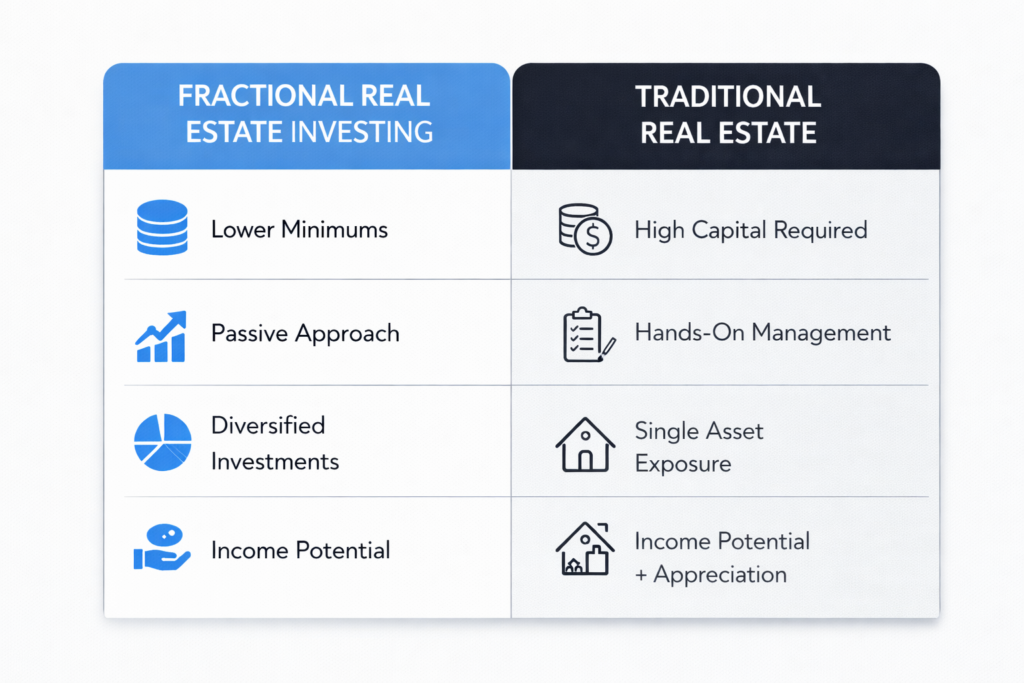
Contrastingly, fractional real estate investing offers a more flexible alternative: Lower investment minimums, passive income potential, diversification across multiple assets.
Because of this, it increasingly overlaps with categories like:
- Fixed income alternatives (predictable returns)
- Real estate investing (asset-backed exposure)
- Private credit investing (loan-based strategies)
Where Groundfloor Fits in Fractional Real Estate Investing
Groundfloor focuses on the debt side of fractional real estate investing. Instead of owning property, investors fund short-term, real estate-backed loans and earn returns through interest payments. These investments are structured and offered directly to investors, providing:
- Transparent, deal-level access
- Standardized investment terms
- Low minimums for accessibility
Unlike many platforms, Groundfloor does not pool investor funds into blind funds or single syndicated deals. Investors can choose individual loans or invest through automated portfolios like Notes. Create an account to see investing options here.
Types of Fractional Real Estate Investing
Fractional real estate investing includes several models, each offering different levels of risk, return, and involvement.
Property Shares (Equity Investing)
You invest directly in a property and earn returns from rental income and appreciation. This is the closest to traditional ownership.
Real Estate Debt Investing
Instead of owning property, you fund real estate loans and earn interest. This approach is commonly used in private credit investing and is often positioned as a fixed income alternative.
Managed Real Estate Platforms
Platforms pool investor capital into diversified portfolios of properties or loans, offering a hands-off investment experience.
Tokenized Real Estate
Blockchain-based ownership structures divide properties into digital shares, allowing for potential liquidity and global access.
Is Fractional Real Estate the Same as a REIT?
No. While both provide exposure to real estate without direct ownership, they work differently. REITs are pooled investment funds managed like public or private companies. Fractional investing gives you exposure to specific properties or loans
With REITs, you typically don’t choose individual assets. With fractional investing, you often have more control over where your money goes, and better visibility into the properties (project and renovation timelines, listing dates, setbacks, and more).
Is Fractional Real Estate the Same as Crowdfunding?
Not exactly, but they’re closely connected. Crowdfunding is the fundraising method, while fractional investing is the investment structure.
- Crowdfunding: Many investors pool money to fund a deal
- Fractional investing: You receive a share of a property or a portion of a loan
In practice, many fractional real estate investments are offered through crowdfunding platforms. The key difference is what you actually own.
Depending on the structure, fractional investing can mean:
- Equity investing: You own a share of a property and earn returns from rent or appreciation
- Debt investing: You invest in a real estate-backed loan and earn interest payments
In debt-based models, investors take on a role similar to a lender, earning income without owning the underlying property.
Unlike traditional real estate crowdfunding platforms that pool investor funds into a single deal or fund, Groundfloor invests directly into individual real estate-backed loans and offers those investments to investors through a regulated structure, providing more transparency, standardized terms, and direct exposure to each loan.
As with any investment, platforms can vary in how they source deals, structure fees, and manage risk. That’s why it’s important to understand the underlying investment model before investing.
Is Fractional Real Estate Investing Risky?
All investing involves risk, but fractional real estate investing can reduce concentration risk through diversification. Instead of investing in one property, you can spread your capital across:
- Multiple properties
- Multiple loans
- Multiple investment strategies
More diversification can help reduce the impact of any single underperforming asset. Real estate and other private market investments are also less likely to dramatically swing with traditional market fluctuations.
Is Fractional Real Estate Investing Liquid?
Fractional real estate investing is generally more flexible than owning property outright, but it is still less liquid than stocks. That said, liquidity can vary depending on the platform and investment structure.
For example, some investments come with fixed terms, while others may offer limited secondary market options. Groundfloor’s real estate-backed Notes are designed with shorter durations (from 1-12 months), making them a much more liquid option within private market investing. Investors can choose to reinvest at maturity or withdraw their funds with no penalty.
However, not all fractional investments offer the same level of flexibility. Investing in individual loans (LROs), or a portfolio of loans, for instance, is typically longer-term. In these cases, investors receive returns as loans are repaid, which can take more time.
Ultimately, while fractional real estate investing is not as liquid as publicly traded assets, it can still provide faster access to capital compared to buying and selling physical property.
How Fractional Investing Fits Into Private Market Investing
Fractional real estate investing is just one piece of the private market investing landscape.
Today’s investors can access multiple categories, including:
- Fixed Income (notes, income products)
- Real Estate (loans, portfolios, rental exposure)
- Private Credit (consumer + real estate credit)
- Private Equity (growth-focused investments)
- Specialty Finance (accredited-only, asset-backed opportunities)
Each category targets different investor goals but can lead to similar products through different entry points.
Why Investors Are Moving Toward Fractional and Private Market Investing
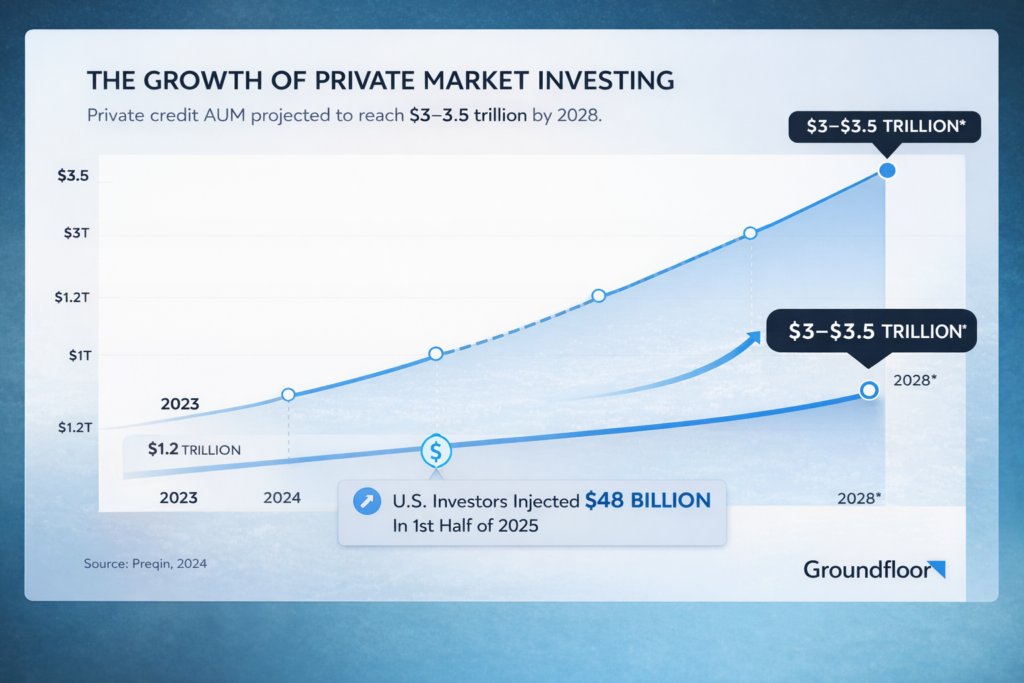
Private credit AUM is expected to reach $3–3.5 trillion by 2028. In fact, high-net-worth investors in the United States injected a staggering $48 billion into private-credit funds in the first half of 2025, surpassing the full-year 2023 total. This massive shift toward private market/fractional real estate investing is part of a larger trend:
- Lower barriers to entry
- Less dependence on the market, less volatility
- Increased demand for passive income
- Search for high yield savings alternatives
- Growth of private credit and alternative investments
So, investors are no longer choosing between stocks and real estate—they’re building multi-asset private market portfolios.
The Future of Real Estate Investing
Fractional real estate investing goes far beyond owning a piece of property. Modern and future investing looks like: Real estate-backed income, diversified credit strategies, and private market opportunities across asset classes.
Start Investing in Fractional Real Estate
If you’re looking to start with fractional real estate investing, consider how it fits into your broader portfolio. For example: Do you want income or growth? Active selection or passive management Real estate exposure or credit-based returns?
By answering these questions, you can move beyond a single investment and begin building a more complete private market investing strategy. Many investors—both new and experienced—start with Groundfloor’s flagship fixed income, high-yield, real estate-backed investment product: Notes.
- Earn consistent income through short-term, real estate-backed loans
- Lock in your rate for the full investment term
- Start with low minimums designed for broad investor participation
Unlike traditional options, Notes are designed to provide consistent income through short-term, real estate-backed loans, while still maintaining accessibility and flexibility. Groundfloor has maintained a 100% track record of repaying full principal and interest on time to every Notes investor, demonstrating consistent performance across market cycles.
With current rates up to 8.25%* and limited-time higher-yield opportunities for accredited investors, Notes are designed to serve as a fixed income alternative within a diversified private market portfolio.
Ultimately, whether you’re just getting started or looking to diversify beyond traditional investments, fractional real estate investing, and specifically real estate debt through Notes, offers a flexible way to build income and long-term portfolio strength.
*Rates subject to change. Lock in your rate for the entire term the moment you invest.