Emerging Alternatives · Accredited Only

Introducing the Auto Finance Portfolio.

Millions of Americans make a car payment every month. This portfolio puts you on the receiving end.

The 2026 Auto Finance Portfolio will acquire whole auto loans through the end of 2026, providing investors with direct exposure to an asset-backed cash flow stream.

Managed in partnership with Parrotfish, a New York-based investment firm led by Stuart Kronick, former head of structured credit at Jefferies, the portfolio leverages a discretionary forward flow program to acquire newly originated loans at 12%+ below face value.

Target net IRR*

13.6%

Distributions

Monthly

Payment Type
Amortized

Average Loan Term

60 Mo
Min. Investment
$10k
$2M hard cap · 1.26× target net multiple · 1099-INT

Proprietary Deal Flow

The portfolio acquires newly originated whole loans through a discretionary forward flow program secured with Automatic USA, a fintech platform connecting independent dealerships and financing providers.

Carrying no purchasing obligation, the program enables us to exercise investment selectivity ahead of the secondary market. In contrast, acquiring loans on the secondary market requires competing on price for pools from which loans have been already purchased by primary buyers.

Embedded Discount as First-Loss Cushion

Every loan is purchased with a 12%+ discount on face value codified in the forward flow structure while acquiring 100% of the principal balance and monthly payments.

Realized at the point of acquisition rather than over time, the discount functions as a first-loss cushion against defaults. Absorbing more than 50% of net loss projections, the discount serves as the primary lever that allows the portfolio to remain profitable across a wide range of performance outcomes.

Augmented by Tech, Managed by Humans

A credit model trained on more than 15 million loan outcomes scores and prices each loan by vehicle, borrower, and dealer. Built by Karus, an auto finance intelligence platform processing more than $50 million in monthly originations, the model produced 66% lower unit default rates than manual underwriting across an $80 million loan pool.

While loans are structured algorithmically, the Parrotfish team retains purchasing discretion, pairing model-driven precision with human judgment.

Market Opportunity

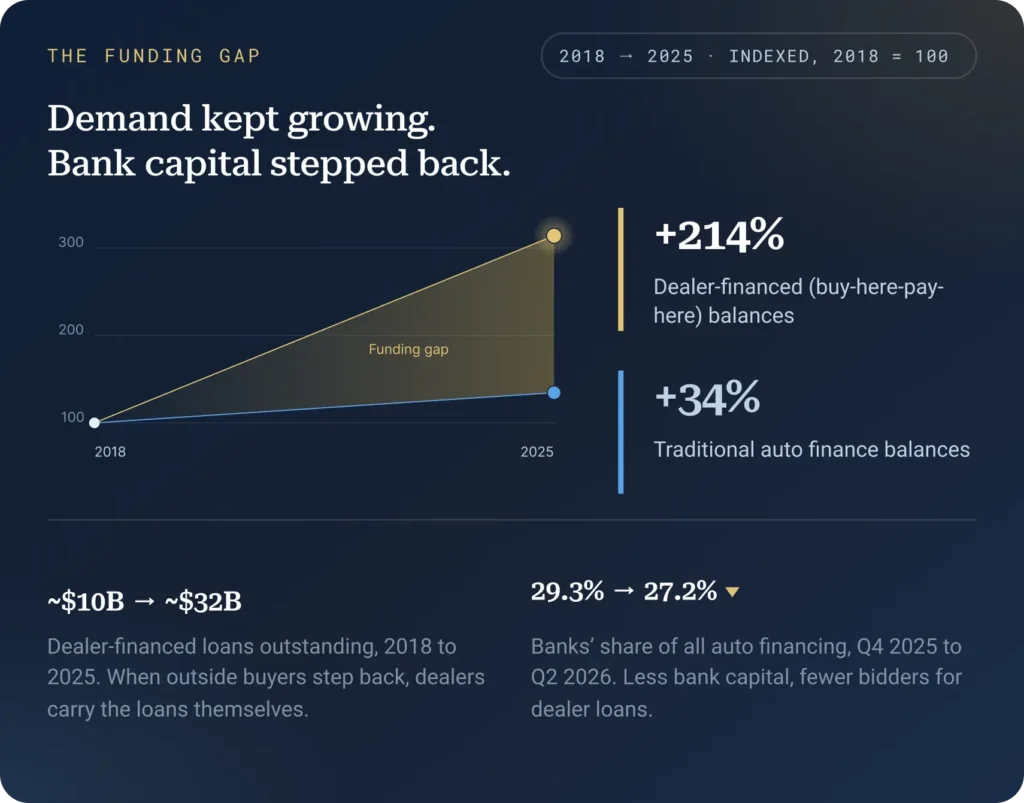
Independent dealerships account for more than half of retail used vehicle sales, yet they lack the captive finance support of franchised dealers. As inflation pushes buyers toward older, more affordable vehicles, demand grows while their financing remains structurally constrained.

The portfolio leverages this dislocation to acquire loans where capital is scarcest, able to remain selective because the segment is structurally underserved rather than distressed.

Investment overview & strategy

Why Choose Auto Loans, and Why Now.

The automobile is the primary mode of transportation across most of the country with more than 75% percent of workers commuting by car, and 90% of households owning at least one vehicle. [1]

The car payment is accordingly among the most resilient obligations in the consumer financial stack, historically paid ahead of credit cards and second only to housing. [2][3]

While today’s inflationary environment pushes buyers toward older, more affordable used vehicles — the core of independent dealer inventory — independent dealerships, which for more than half of retail used vehicle sales [4] remain constrained in their access to financing. [5][6]

The Auto Finance Portfolio provides capital to this underserved dealer segment through loans backed by a payment stream that consumer historically prioritize. Loans are acquired at a discount, selected by the Parrotfish team, and priced with a data-driven credit model to offer exposure to an income stream derived from an essential, asset-backed consumer obligation.

01 · The market

U.S. auto loans outstanding, mid-2026

$1.71T

An essential asset with decades of standardized performance data, allowing every loan to be priced by vehicle, borrower and dealer, and stress-tested before purchase.

02 · The Payer

Consumers have paid the car loan ahead of their credit cards

Since 2003

The car is how most people get to work, so its payment is one of the last a stretched household lets slip. TransUnion has found it paid ahead of credit cards since at least 2003, and ahead of the mortgage for much of that time.
03 · The discipline
Of underwriting on every loan, and no obligation to buy

2 Layers

Karus scores and prices each loan at the point of sale; Parrotfish reviews the month’s flow and takes only what fits. If quality slips, buying can slow or stop, with no penalty.

Investment overview & strategy
Aligned Incentives on Discounts

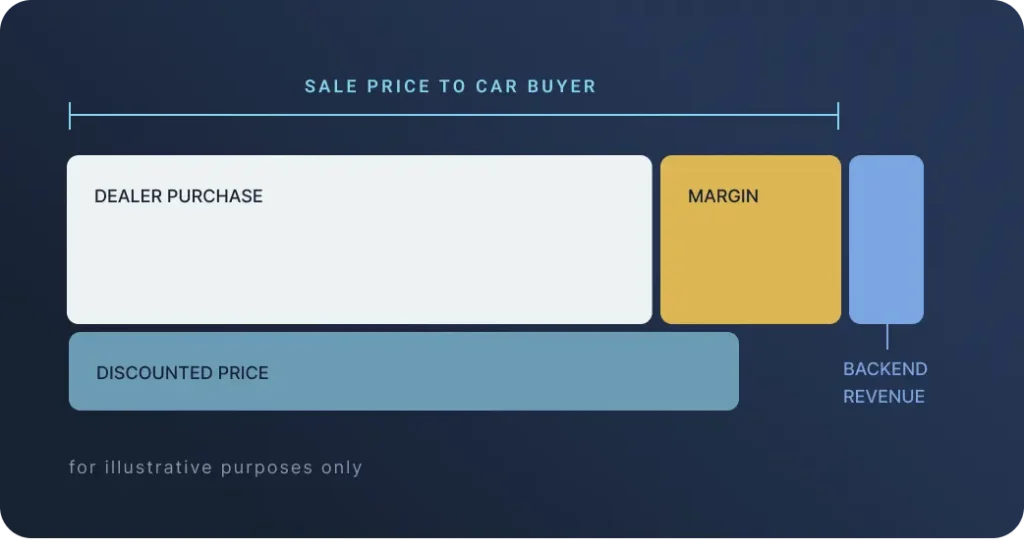
Independent dealers earn their return on volume. As their business model relies on fast turnover of inventory, closing a sale outweighs preserving the full margin on any single loan at the risk of an aging lot. Beyond the margin against the original purchase price, a car sale generates revenue for the dealer as an opportunity to sell back-end products including warranties and service contracts offered at the point of sale.
The automobile is the primary mode of transportation across most of the country with more than 75% percent of workers commuting by car, and 90% of households owning at least one vehicle. [1]

The car payment is accordingly among the most resilient obligations in the consumer financial stack, historically paid ahead of credit cards and second only to housing. [2][3]

While today’s inflationary environment pushes buyers toward older, more affordable used vehicles — the core of independent dealer inventory — independent dealerships, which for more than half of retail used vehicle sales [4] remain constrained in their access to financing. [5][6]

How it works

Buy Below Face Value. 
Own the Whole Loan.

A car loan is simple credit: advanced at the dealership, repaid in level monthly installments over 60 months, and secured by the vehicle. Three things drive the return: the purchase discount, which sits in front of losses; the interest rate, paid while each loan performs; and fast amortization, which shrinks what’s at risk each month. Losses are built into the plan.

Subscriptions are held in Groundfloor Notes between loan purchases, so your money earns while the portfolio buys through the end of 2026. Distributions are paid monthly.

Interactive · The monthly math

Paid Monthly. Principal and Earnings in Every Payment.

Your 14.0% target is paid as monthly distributions, not a lump sum at year six. Choose an amount and a scenario to see each payment split into principal returned and new earnings.
Projections from the portfolio's deal model · not a forecast
Credit scenario
Principal returnedEarningsCumulative cash receivedYour capital
Base case on $25,000: estimated first payment $618, peak about $893 around month 15, capital back by month 34, $31,750 in total. Months are counted from deployment into loans; until then, subscribed capital earns in Groundfloor Notes. Hover or touch the chart for any month.
Estimated first monthly payment
$618
Est. $342 principal · $276 earnings
Back in your first 12 months
$8,719
35% of your investment
Back within 24 months
$18,912
76% of your investment
Capital fully returned
Month 34
Every payment after this is gain
Total paid to you
$31,750
Over about five years · 1.27× your capital
Total gain over capital
$6,750
At a 14.0% target net IRR* (target)
Across the three modeled scenarios · on $25,000
Base case = target
Upside · 17.1%
$33,470 · gain $8,470 · back by mo 33
Base case · 14.0%
$31,750 · gain $6,750 · back by mo 34
Downside · 7.9%
$28,654 · gain $3,654 · back by mo 40

The portfolio's deal model, scaled to your amount; each payment is split into principal and earnings at the scenario's internal rate of return. In every modeled scenario you receive more than you invested; in the downside case the gain is smaller and takes longer. Projections, not a forecast or a guarantee; you may lose principal.

The partnership

Industry Experts at Every Step. A Platform Built for Access.

Every Emerging Alternatives offering is led by a specialist with deep experience in its market, vetted by Groundfloor. In auto credit, that specialist is Parrotfish: credit experts who choose every loan, one at a time.

Our industry-expert partner · The manager · Asset-backed private credit

Parrotfish is a New York specialty finance firm led by Stuart Kronick, former head of the Structured Credit Group at Jefferies. Its team has spent about five years financing independent auto dealers and their buyers. It scores the borrower, the dealer, and the vehicle, and passes on any loan that doesn’t fit. Every loan is secured by a titled vehicle.

Stuart Kronick

Founder & Managing Partner

25+ years in structured credit. Led Jefferies’ Structured Credit Group. Founded and exited VMAC, a vehicle-leasing company, and Steamboat Solar.

Jacob Zeldin
Partner

Former portfolio manager at Monachil Capital Partners, running credit strategies across two private funds focused on consumer, small-business and auto finance.

Parrotfish Investments · Investment Partner
Parrotfish serves as the investment manager of the portfolio, maintaining discretion on loan purchases within the forward flow program.
Karus · Underwriting Platform

Credit intelligence for auto finance: models trained on more than 20 million loan outcomes price each application to a target yield. CEO Aaron Travis co-founded Random Forest Capital, a credit and data-science firm acquired by Franklin Templeton in 2018.

Automatic USA & Signal Lending · Origination Platform; Servicer
Automatic USA connects independent dealerships with financing sources. Signal Lending, an affiliate lender, closes each loan and remains as servicer after loans are purchased by the portfolio.
Groundfloor, since 2013

12 Yrs

Invested across offerings

$2.2B+

Investors
250k+
Recent Emerging Alternatives sold out early

3 of 3

Inc. 5000 six consecutive years · Best Alternative Investment Platform, 2025 Benzinga Global Fintech Awards. The SMB Growth Fund, the first Music Royalties allocation and the Pre-IPO Stock Finance Portfolio each reached their caps early; the SMB Growth Fund in about 48 hours. Past performance is not indicative of future results.

Why this is rare

Six Years on Paper. Most of Your Capital Back in Two, Then the Profit on Top.

The maximum term is six years. In the base case, capital is returned around month 34, followed by about $2,700 of earnings per $10,000. Figures are modeled estimates, and actual payments will vary.

Month1Capital coming home
Est. monthly payment$618
Est. received so far$618
Capital back (est.)2%
Est. profit on top$0
Projected on $25,000 · base case
DeployedYear 1Year 2Year 3Year 4Year 5
  1. ~35% back · year 1
  2. ~75% back · month 24
  3. Capital back · month 34
  4. Final payments · month 60
Projected estimate, not a forecast or a guarantee. Base-case deal model; actual monthly payments will vary with loan performance, prepayments and the timing of purchases and collections, and you may receive less than shown or lose principal. Subscriptions Oct–Dec 2026, held in Groundfloor Notes between loan purchases; months are counted from deployment into loans. The curve is the modeled monthly payment for the amount selected; the fill turns gold once your capital is back.
OCT 20 – DEC 2026
Subscribe and deployCapital is held in Groundfloor Notes while the portfolio buys loans through the forward-flow program each month.
MONTHS 1 – 24
Payments build, capital comes homeMonthly distributions from the first month after deployment; about 75% of your investment back within 24 months.
MONTH 34 → 60
Paid back, then the profit on topCapital fully returned around month 34; every payment after that is earnings on top, about $2,700 per $10,000, as the last loans amortize through about month 60.
Why it stands out

Earn From the Car Payments Americans Make Every Month.

Most investments rise and fall with the same forces: company earnings, interest rates and property values. The Auto Finance Portfolio earns from something more everyday: the payments people make on the cars they drive to work. Starting at $10,000, you earn from the cash flow of roughly 140 vehicle-backed loans, paid out every month, with most of your capital modeled back inside two years.
A new return engine for your portfolio
Earnings come from monthly car payments across roughly 140 loans, not from stock prices, rate moves or property values.
Cash in hand every month
Principal and earnings arrive together from the first month after deployment, with about 75% of capital modeled back within 24 months.
Bought at a discount, backed by the car
Every loan is bought at no more than 88¢ on the dollar and secured by a titled vehicle, targeting a 13.6% net IRR* after modeled defaults and fees.
Expert-picked loans, from $10,000

Parrotfish hand-selects every loan from first-look flow that has usually gone to institutional buyers.

Risk considerations

What to Weigh, and How the Portfolio Is Built for It.

Returns are targets, not promises, and you may lose principal. The considerations below come from the offering’s investment materials, each with the structural feature that addresses it.

Credit losses

Borrowers are near- or sub-prime, and defaults are expected. The base case assumes a 21.4% default rate with 35% recovery; the fixed 12% discount is designed to absorb roughly 70% of projected net losses, and the modeled return stays positive through the downside case.

Projections

No loans have been bought yet, so the return figures are projections from the deal model, not a track record. The underwriting behind them draws on more than 20 million historical loan outcomes.

Collateral

Every loan is secured by a titled vehicle, with title assigned to the Groundfloor subsidiary at purchase. The modeled scenarios assume 30–35% recovery at auction on a defaulted balance.

Partners

Origination, underwriting and servicing run through Automatic USA, Karus and Signal Lending on contracted terms, with Parrotfish overseeing the program. The portfolio can decline any loan, dealer or month.

Liquidity

No early redemption and no secondary market. Capital returns as the loans pay down, most of it within the first two years in the base case.

Structure

You hold a payment-dependent note issued by a Groundfloor subsidiary that owns the whole loans and their titles. Distributions depend on the cash those loans produce.

Opens October 20.
Three Steps to Your Allocation.

A $2 million hard cap, first come, first served; the offering closes when the cap is met or after three months, whichever comes first. A few minutes if your accreditation is already on file.

2 MIN

Create your account

Or sign in if you already have one.

5 MIN

Confirm your accreditation

Complete verification on the platform before October 20 so you are ready on launch day.

TODAY

Invest, from $10,000

Fund your investment and you’re in. Transfers can take several days to settle, so connect your bank before launch day.

Three steps to invest
Read before you commit

Common Questions. Direct Answers.

Every term is in the offering documents. Review them, then invest on October 20; allocations fill in the order investments arrive.


Sources

Groundfloor logos R4 11

We're Making Borrowing Even Better!

You’re entering our enhanced site experience, built specifically for borrowers and lending partners.