Groundfloor expanded its private markets platform this week with the launch of the Pre-IPO Stock Finance Portfolio, a new Emerging Alternatives offering available exclusively to Groundfloor’s accredited investors.
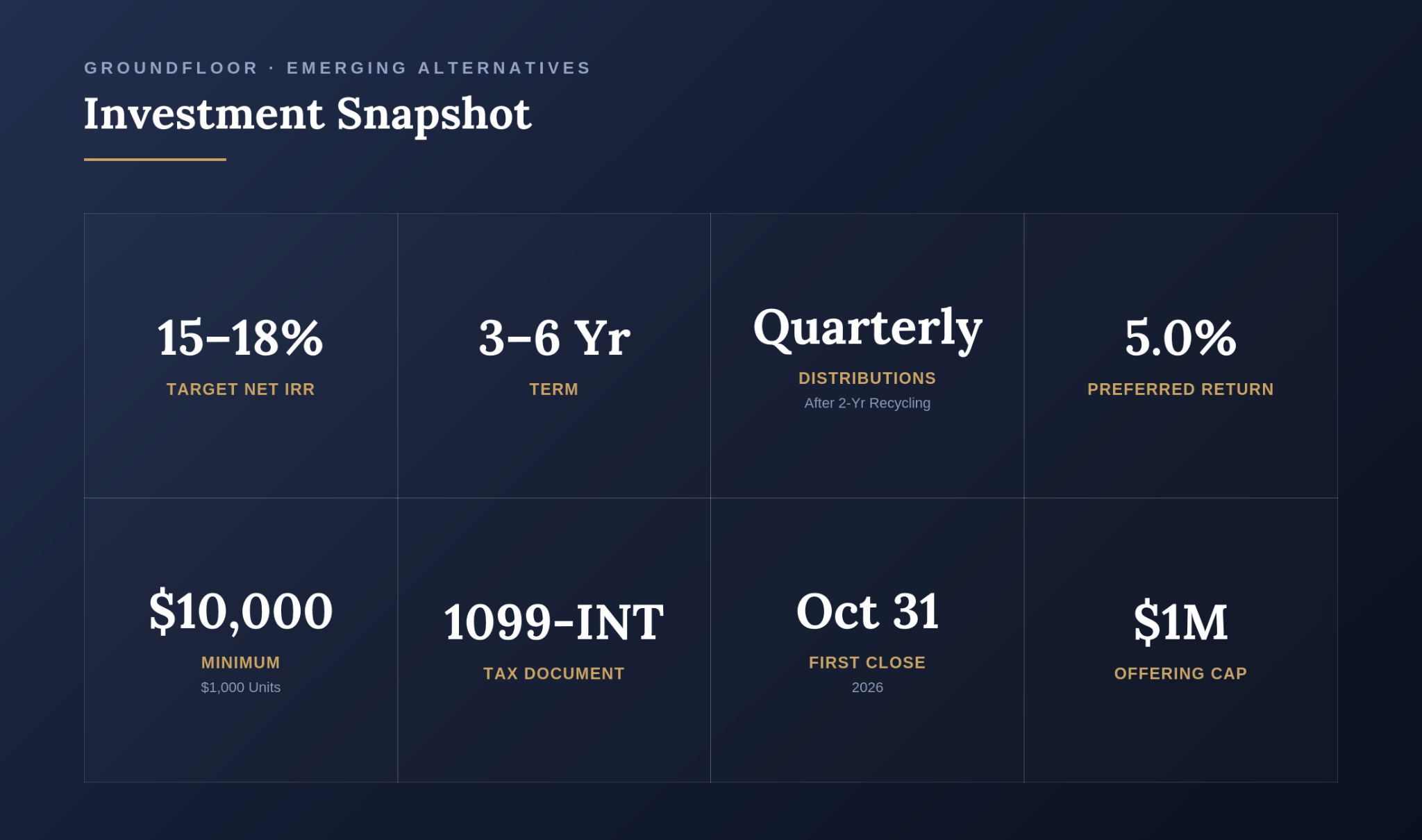
The portfolio targets a 15–18% net internal rate of return (IRR) over a projected 3- to 6-year hold by financing the shareholders of late-stage private companies — rather than buying their shares outright. Investors receive quarterly cash distributions following an initial two-year recycling phase, plus additional upside from equity appreciation captured when portfolio companies exit.
Managed in partnership with Serengeti Asset Management, a New York-based stock finance platform, the portfolio provides diversified exposure across roughly 25 late-stage private companies selected from a global universe of more than 1,000 companies valued above $1 billion.
Like every Groundfloor offering, we rigorously vet, curate, and structure the portfolio for individual investors, while an experienced specialist manages the underlying assets. The result: access to a financing strategy that has historically been reserved for pensions, endowments, and family offices.
Invest in the Pre-IPO Stock Finance Portfolio Now
Where Your Return Comes From
Pre-IPO investing has two sides. Most investors only see the expensive one — buying the shares and hoping the company’s value climbs enough to justify the price.
Institutions work the other side: they lend to the shareholders who already hold that stock, secured by the shares themselves, and get paid in compounding interest plus a share of the gain at exit. The Pre-IPO Stock Finance Portfolio puts individual investors on that side of the trade for the first time.
The strategy produces two complementary sources of return:
- First, PIK (paid-in-kind) interest accrues and compounds quarterly against the pledged collateral — generating a credit-like baseline return even if a company’s valuation stays completely flat.
- Second, at exit, a stock fee — targeted at roughly a third of the amount originally advanced — captures a share of any equity appreciation. This upside is uncapped.
Together, these two return drivers underpin the portfolio’s target 15–18% net IRR.
Rather than betting on which private company will be the next breakout name, the strategy is built around companies that are already well capitalized, already growing, and already approaching a likely exit — with the loan secured by their stock the entire time.
How the Strategy Works
The Pre-IPO Stock Finance Portfolio gives investors credit exposure to a portfolio of asset-backed financings originated and managed by Serengeti Asset Management.
- Serengeti advances cash to shareholders of late-stage private companies — typically employees and early investors holding stock they can’t easily sell — secured entirely by their pledged shares.
- Every position is overcollateralized 2–3× by that pledged stock, leaving substantial excess collateral to help buffer against principal impairment.
- The pledged shares move into a bankruptcy-remote trust before a dollar is funded. Neither Serengeti nor the shareholder can sell, transfer, or re-pledge them while the financing is outstanding — the trust can only be accessed by the lender, and only once a qualifying trigger occurs.
- PIK interest compounds quarterly against the collateral, generating a credit-like baseline return.
- At exit, a stock fee shares in any equity appreciation — so investors participate in the upside without taking on full equity risk.
- A 5.0% preferred return puts investor capital ahead of any Groundfloor fees.
- Distributions are paid quarterly following an initial two-year recycling phase; the target hold period is 3–6 years.
From a global universe of more than 1,000 private companies valued above $1 billion, Serengeti underwrites roughly 25 investments against a framework examining fundraising stage, IPO likelihood, secondary-market activity, and business-model viability. Twenty-five names means no single company decides the portfolio’s outcome.
Groundfloor independently evaluated the manager, the strategy, and the structure before opening the offering to investors.
Why Pre-IPO Stock Finance?
Private companies are staying private longer, and raising more money before they ever list — which means more of their value is being created and realized in private markets rather than at the IPO.
That has produced two facts sitting side by side. There’s a deep backlog of IPO-ready companies built up after a multi-year lull in public listings. And step-ups at the IPO itself have gotten smaller: over the past decade, roughly six in ten technology IPOs stepped up 2x or less from their last private funding round, with a median step-up of about 1.7x.
An investor who buys shares directly at the last private valuation is paying for upside that may already be priced in. A lender, by contrast, gets paid on the exit itself — interest that compounds while the company waits to go public or get acquired, plus a share of whatever gain does materialize.
This structure is built around not picking losers — collecting a credit-like return on the wait, and a piece of the upside on the outcome, whatever it turns out to be.

Watch Now: Brian Dally sits down with Ray Yousefian, Senior Managing Director at Serengeti, on the state of the late-stage private market, what the IPO backlog and AI capex signal for exits, and how a stock-finance position is built to hold up in a down-round — now open to individual investors.
Part 1: Serengeti’s Structured Approach to Late-Stage Private Tech
Part 2: Market Trends, AI CapEx Signals, and More About Stock Finance with Serengeti Asset Management
Why Institutional Investors Have Embraced Pre-IPO Stock Finance
Institutions have financed pre-IPO shareholders for years, for a straightforward reason: it converts an illiquid, single-outcome equity bet into a structured position with a defined collateral cushion and a contractual claim to interest.
The strategy behind this portfolio is built around companies with real capital efficiency and a plausible near-term path to an exit — an IPO, an acquisition, a tender offer, or, at minimum, a defined maturity date at which the financing resolves. Rather than relying on picking a future winner, the portfolio focuses on shareholders and companies for which a liquidity event is a realistic, underwritten outcome.
The strategy also addresses a structural gap in the market: many pre-IPO shareholders — employees with expiring options, early investors wanting liquidity without selling into a discounted secondary — need financing, not a buyer for their shares. Serengeti fills that gap directly.
For investors, the result is exposure to return drivers that differ meaningfully from traditional public equities, corporate credit, and much of real estate-backed investing.
A Complement to a Diversified Private Market Portfolio
Pre-IPO stock finance occupies a distinct position within alternative investments.
Unlike public equities, its returns aren’t driven primarily by daily market sentiment. And unlike buying private shares outright, its downside isn’t tied one-to-one to a company’s valuation — the pledged collateral and accruing interest provide a buffer that direct equity ownership doesn’t have.
For investors building a diversified private-markets allocation, pre-IPO stock finance may complement:
- Real estate credit
- Private credit
- Music royalties and other specialty finance
- Direct private equity or venture positions
Together, these strategies provide exposure to multiple, largely independent sources of return rather than concentrating in any single asset class.
Professionally Managed from Investment Through Exit
Following investment, Groundfloor’s Investments team oversees investor administration, distributions, and ongoing portfolio communications, while Serengeti Asset Management originates, underwrites, and manages the underlying financings.
Investors receive quarterly cash distributions as financings are repaid, plus straightforward 1099-INT tax reporting. The structure gives investors institutional-style exposure to pre-IPO stock finance without requiring them to source shareholders, negotiate financings, or manage collateral themselves.
An Illustrative Look at the Numbers
The figures below are illustrative only — hypothetical examples meant to show how the structure behaves, not a projection, quote, or guarantee of this portfolio’s results. Actual results will differ, and investors may lose principal.
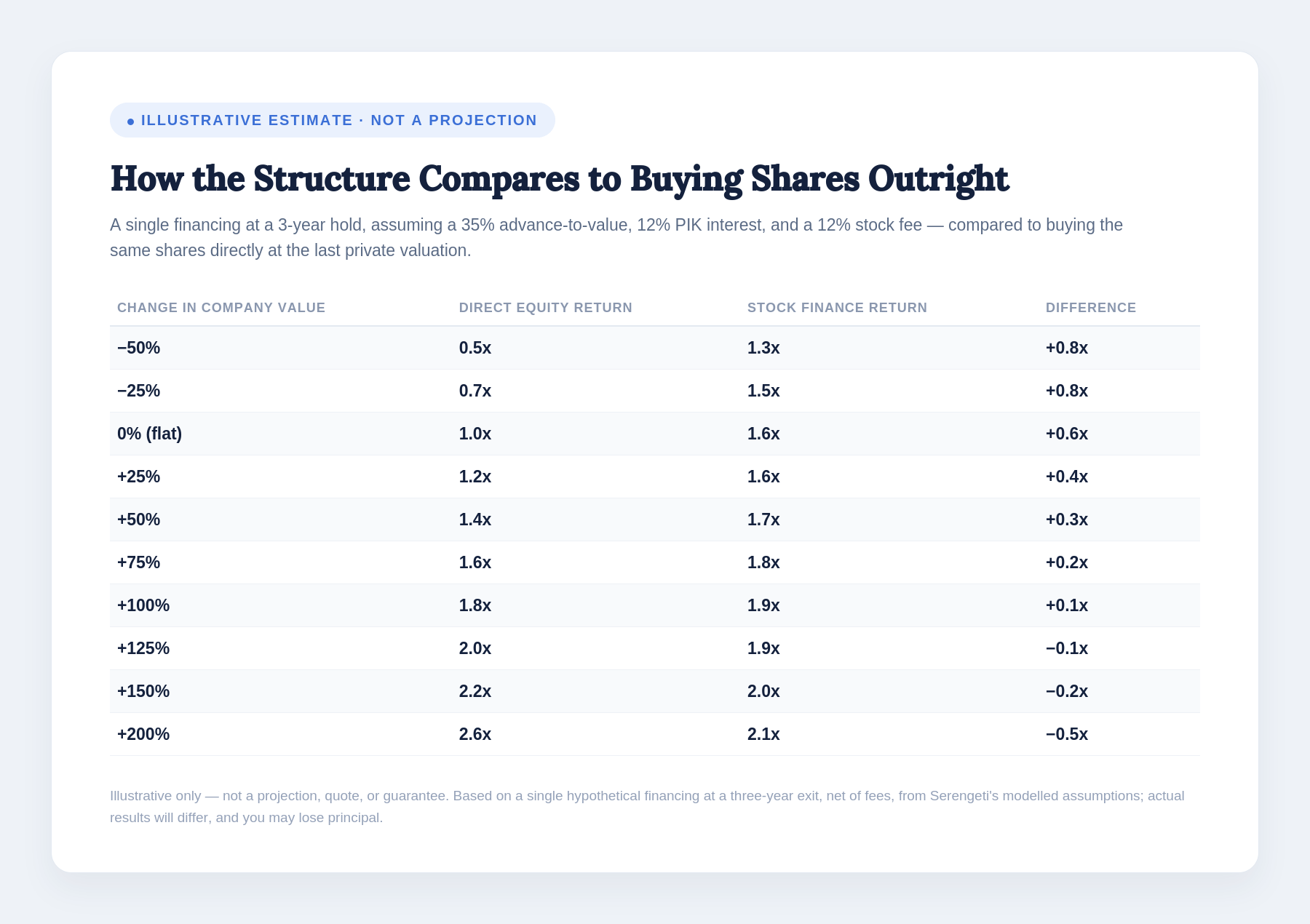
In this illustration, the structure outperforms owning the shares outright in every scenario where the company’s value stays flat, declines, or grows by less than roughly 125% — which is where the large majority of technology IPOs over the past decade have landed. Only past that point does direct ownership start to pull ahead, because the compounding interest and stock fee then cost more than the downside protection was worth.
What a hypothetical commitment could return, under three scenarios. Serengeti models the portfolio under downside, base-case, and upside assumptions. The illustration below shows the estimated multiple on invested capital under each, at the portfolio level over the full term.
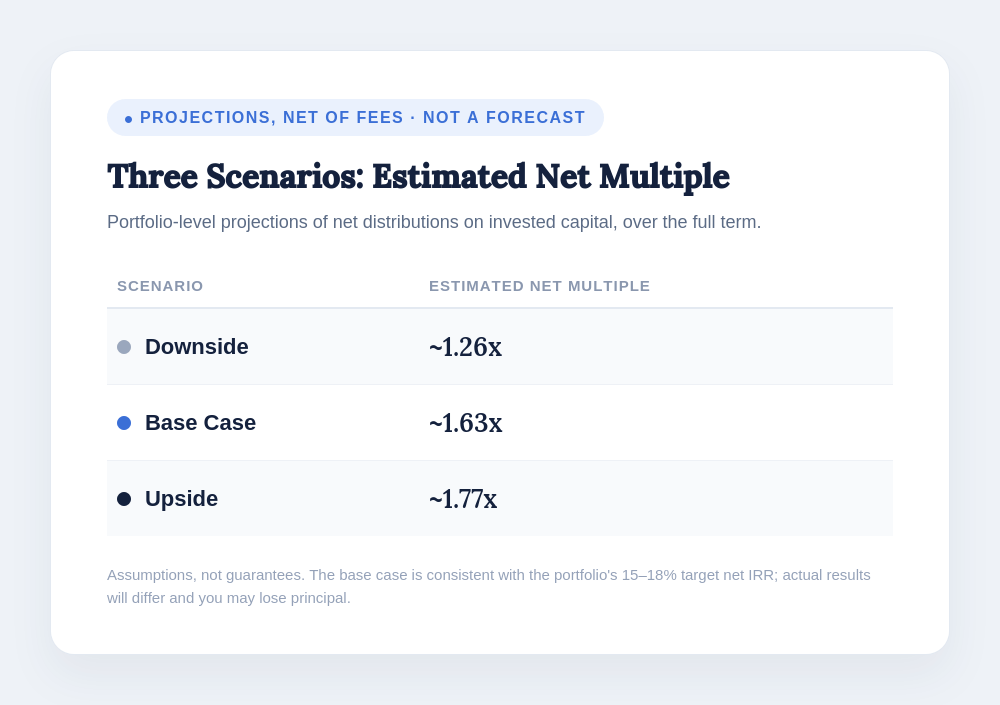
The base case is consistent with the portfolio’s 15–18% target net IRR. In the downside case, the portfolio is still modeled to return more than investors committed — just on a longer timeline, since exits can take longer than expected to materialize. These are assumptions used to illustrate how the structure is designed to behave, not a forecast of actual results.
Key Considerations
Like all private-market investments, the Pre-IPO Stock Finance Portfolio involves risk and should be evaluated as part of a diversified portfolio.
Prospective investors should consider that:
- Target returns are objectives and are not guaranteed.
- The investment has an expected hold period of 3–6 years, with no secondary market and no interim redemption.
- No distributions are made during the initial two-year recycling phase; quarterly distributions begin after that.
- Overcollateralization reduces, but does not eliminate, the risk of principal loss — a steep enough decline in a portfolio company’s value can still test coverage.
- Private investments are generally less liquid than publicly traded securities.
Because bank transfers can take several business days to settle before funds are allocated to an investment, interested investors should confirm their accreditation and initiate funding early — the offering is capped at $1,000,000 and will close once fully subscribed.
The Pre-IPO Stock Finance Portfolio introduces a differentiated strategy built around one side of the pre-IPO market that individual investors have rarely been able to access: the lender’s seat.
By combining a 2–3× collateral cushion on every position, compounding PIK interest, uncapped equity participation at exit, quarterly distributions, and a target 15–18% net IRR, the portfolio gives accredited investors exposure to a strategy that has historically been available primarily through institutional managers.
As Groundfloor continues expanding beyond real estate into a broader set of private-market opportunities, the Pre-IPO Stock Finance Portfolio reflects the company’s mission of making institutional-quality alternative investments more accessible, while continuing to build a diversified platform for long-term investors.
Why Groundfloor Is Expanding Beyond Real Estate
Groundfloor has spent more than a decade helping individual investors access private-market opportunities that were once reserved primarily for institutions.
While the company’s foundation remains real estate-backed investing, the Pre-IPO Stock Finance Portfolio reflects Groundfloor’s continued expansion into specialty finance and alternative income-producing strategies.
The investment follows the same philosophy behind Groundfloor’s broader platform: identify an institutional-quality strategy, perform rigorous due diligence on the manager, structure the investment for individual investors, and provide professional administration throughout the life of the investment.
For investors, that means gaining exposure to a strategy that would otherwise require direct institutional relationships and a minimum investment far out of reach for most individuals.
Create an account now to browse all available investment opportunities – both Regulation A and Regulation D. Verify your accreditation in the platform in just minutes to access Regulation D opportunities.
Frequently Asked Questions
What is the Groundfloor Pre-IPO Stock Finance Portfolio?
The Groundfloor Pre-IPO Stock Finance Portfolio gives accredited investors credit exposure to a portfolio of financings secured by pre-IPO shares in roughly 25 late-stage private companies. The portfolio targets a 15–18% net IRR through PIK interest that accrues during the hold and a stock fee captured on equity appreciation at exit, over an expected 3- to 6-year term.
Am I buying shares in these companies?
No. The portfolio finances the shareholders who already own the stock — advancing cash to an employee or early investor against their shares, which are then held as collateral until the company exits. Investors hold a payment-dependent note issued by the offering’s SPV, not shares in any portfolio company and not fund units.
How does pre-IPO stock finance generate returns?
The portfolio generates returns in two ways. First, PIK interest accrues and compounds quarterly against the pledged collateral, producing a credit-like baseline return even if a company’s valuation stays flat.
Second, at exit — an IPO, acquisition, tender offer, or contractual maturity — a stock fee captures a share of any equity appreciation, uncapped. Together, these two sources contribute to the portfolio’s target return.
Is this a bet on picking the next breakout company?
No. The strategy focuses on underwriting shareholders and companies where a liquidity event is a realistic, well-supported outcome, rather than trying to predict which private company will deliver the biggest gain. Each financing is overcollateralized 2–3× by the pledged shares, and the portfolio diversifies across roughly 25 companies, so no single name determines the outcome.
What are the target returns and investment terms?
The portfolio targets a 15–18% net IRR over an expected 3- to 6-year hold. Distributions are paid quarterly, following an initial two-year recycling phase.
Key terms include:
- $10,000 minimum investment, in $1,000 units
- Quarterly distributions after the two-year recycling phase
- 5.0% preferred return
- 1099-INT tax reporting
- $1,000,000 offering cap
- Available exclusively to accredited investors under Regulation D
Investment objectives are targets only and are not guaranteed.
Who manages the investment?
Groundfloor oversees the investment from commitment through exit, handling investor administration, distributions, and portfolio oversight. Serengeti Asset Management, a New York-based stock finance platform, originates and manages the underlying financings. Investors commit capital once, while Serengeti manages sourcing, underwriting, collateral administration, and exits.
This article is for informational purposes only and is not an offer to sell, or a solicitation to buy, any security — that’s made only through the official offering documents, which investors should read before committing. Nothing here is investment, legal, or tax advice.
The Pre-IPO Stock Finance Portfolio is available only to accredited investors under Regulation D. Target returns are targets, not guarantees — actual results may differ. Investing involves risk, including possible loss of principal. Past performance is not indicative of future results.