Markets Keep Finding New Reasons to Be Unpredictable
The past few years have reminded investors that volatility rarely arrives from just one direction.
Inflation has proven far more persistent than many economists expected. Interest rates remain elevated. Equity markets continue reacting sharply to AI optimism one week and recession fears the next. Energy prices have become increasingly difficult to forecast as geopolitical tensions and supply disruptions reshape global markets almost overnight.
For long-term investors, market swings are nothing new. But for investors approaching retirement—or simply looking to preserve a portion of their portfolio—the question becomes less about chasing the next rally and more about creating stability.
One increasingly common answer is allocating part of a portfolio to fixed-income investments with defined timelines and predictable returns.
Retirement Investing in 2026
As retirement approaches, investment priorities often begin to change. Instead of maximizing upside, many investors begin focusing on balancing growth with capital preservation, income generation, and liquidity. Large market drawdowns become more difficult to recover from when there are fewer working years ahead.
That doesn’t necessarily mean abandoning stocks altogether.
Instead, many investors gradually diversify into assets designed to reduce portfolio volatility while still generating meaningful returns.
Historically, bonds have filled that role. Today, many investors are also considering private fixed-income investments that offer defined terms and predictable yields without daily market price fluctuations.
Inflation Is Still a Long-Term Consideration
While inflation has moderated from its recent highs, prices remain well above where they were only a few years ago.
For retirees and income-focused investors, inflation presents a unique challenge. Cash sitting in low-yield accounts gradually loses purchasing power, while remaining fully invested in equities can expose portfolios to significant short-term swings.
Finding investments that generate fixed returns over relatively short periods can help bridge that gap. Rather than locking money away for years, some investors prefer shorter maturities that allow them to reassess their allocation as market conditions evolve.
Shorter Terms Can Create More Flexibility
One challenge with many fixed-income investments is commitment. Long-duration bonds can fluctuate significantly as interest rates change. Multi-year CDs often limit access to capital without penalties. Some alternative investments require investors to commit funds for five years or longer.
Shorter-duration investments offer a different approach. Knowing when capital is expected to return allows investors to adapt as opportunities change, whether that’s reinvesting into another fixed-income product, increasing equity exposure, or simply maintaining liquidity.
For investors who expect markets to remain uncertain over the next several quarters, six months can represent a useful balance between earning a meaningful return and maintaining flexibility.
Fixed Income Doesn’t Have to Mean Low Returns
For years, investors accepted that stability often came with relatively modest returns. Today’s private markets have expanded the range of fixed-income opportunities available to accredited investors.
Rather than relying solely on traditional savings products or publicly traded bonds, investors can now access private fixed-income investments with defined terms, contractual returns, and investment structures that don’t fluctuate alongside public markets each trading day.
Like any investment, these opportunities carry risks and should be evaluated carefully within the context of an overall portfolio. But they demonstrate that seeking stability doesn’t necessarily require accepting minimal income potential.
One Way to Reduce Portfolio Stress
No one can predict where markets will move next. Artificial intelligence continues reshaping entire industries. Inflation remains an ongoing concern, and the modest rates on traditional savings products are no longer keeping up. Energy markets can shift dramatically with global events, while equity markets continue reacting to each new economic report.
Rather than attempting to predict every headline, investors instead choose to position a portion of their portfolio in investments designed to deliver predictable outcomes regardless of daily market sentiment.
That doesn’t eliminate risk, but it can reduce the amount of a portfolio exposed to short-term market swings.
A New Six-Month Fixed-Income Opportunity
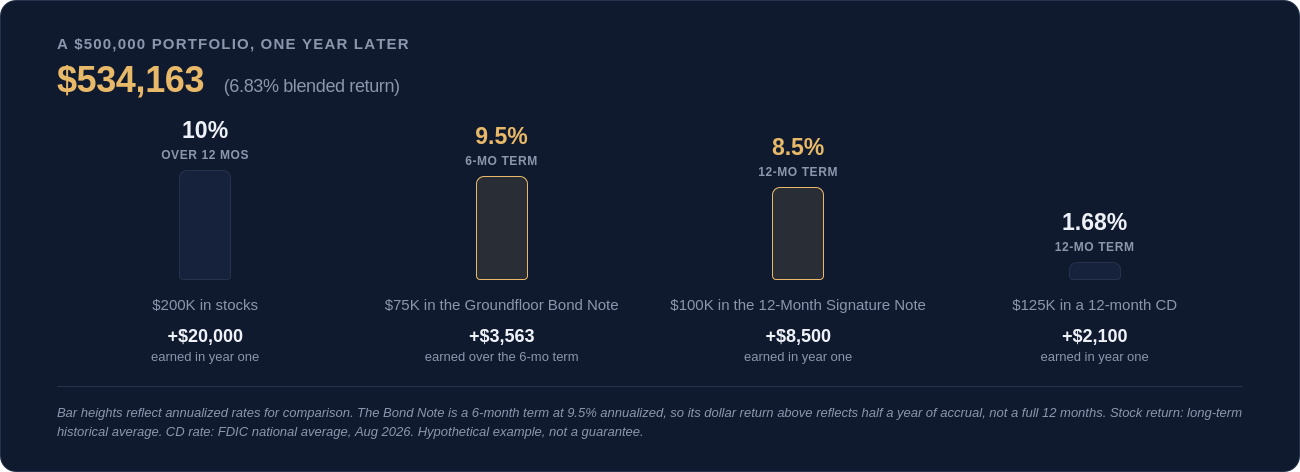
Beginning August 3, Groundfloor’s new Bond Note offers accredited investors a 9.5% fixed annualized return over a defined six-month term. This offering has previously sold out in a matter of days, so interested investors are encouraged to create an account and transfer funds promptly before the cap fills.
Investors who are not accredited may also consider Groundfloor’s 12-Month Signature Note, which offers an 8.5% fixed annual return with monthly interest payments and is backed by a diversified pool of residential real estate loans managed by Groundfloor.
The Bond Note offers a shorter six-month investment horizon while the Signature Note offers a longer-term income-producing investment. Both offerings reflect the growing range of private fixed-income options available to investors, especially those around retirement, looking to reduce exposure to day-to-day market volatility while earning a defined return.
Open for All Investors: 8.5% Fixed-Rate 12-Month Note
Groundfloor also offers fixed-income investments available to a broader range of investors through its Notes products. Most popular is the 12-Month Signature Note. The Note currently offers a locked-in 8.5% fixed annual return with monthly interest payments over a 12-month term.
Unlike the Bond Note, which is issued directly by Groundfloor to support its lending operations and broader capital strategy, the Signature Note is backed by a diversified pool of residential real estate loans originated, underwritten, and managed by Groundfloor. By spreading exposure across many loans rather than relying on a single property, the structure is designed to provide diversification within the underlying portfolio while delivering a defined rate of return over the investment term.
For investors who don’t meet accredited investor requirements but are looking for predictable income outside of traditional savings products, it represents another example of how private fixed-income investing has become more accessible in recent years. Create your account and invest in the 12-Month Note here.
Related reading: 9.5% Fixed-Rate Bond Note: A New Six-Month Fixed-Income Opportunity
Frequently Asked Questions
Is fixed income a good investment during market volatility?
Many investors use fixed-income investments to help reduce overall portfolio volatility during uncertain markets. Unlike stocks, many fixed-income investments offer defined terms and predetermined returns, making them a common choice for investors seeking greater predictability. The right allocation depends on your financial goals, risk tolerance, and investment timeline.
Why are investors moving money into fixed-income investments in 2026?
Persistent inflation, elevated interest rates, and ongoing stock market volatility have led many investors to increase their allocation to fixed income. Short-term fixed-income investments can provide defined returns while allowing investors to preserve flexibility if market conditions change.
What are the benefits of a short-term fixed-income investment?
Short-term fixed-income investments typically return capital sooner than long-term bonds or many alternative investments. This shorter investment horizon allows investors to reassess market conditions, reinvest elsewhere, or access their capital sooner while still earning a fixed return during the investment term.
What is the Groundfloor Bond Note?
The Groundfloor Bond Note is a six-month fixed-income investment available to accredited investors. It offers a fixed 9.5% annualized return, with accrued interest and principal paid together at maturity. Unlike publicly traded bonds, the Bond Note is a Note issued directly by Groundfloor to support its lending operations and capital strategy.
Who should consider the Groundfloor Bond Note?
The Groundfloor Bond Note may appeal to accredited investors seeking a defined return over a relatively short investment horizon. It can be an option for investors looking to diversify beyond public markets, temporarily allocate cash while waiting for future opportunities, or incorporate fixed-income investments into a broader portfolio strategy. As with any investment, investors should carefully review the offering documents and consider the associated risks before investing.
This article is for educational purposes only and does not constitute investment, legal, tax, or financial advice, or an offer to sell securities. All investments involve risk, including the possible loss of principal. The Groundfloor Bond Note is not FDIC insured, is not a bank deposit, and is available only to accredited investors. Past performance, including Groundfloor’s historical payment record, does not guarantee future results. Please review the applicable offering documents before investing.