
Investors searching for reliable income are facing a different environment in 2026. Savings accounts and CDs are offering lower yields, while inflation and shifting interest rates continue to impact real returns.
As a result, private credit investing is gaining attention as a fixed income alternative. What was once limited to institutions is now becoming more accessible to individual investors, creating new ways to generate income and diversify portfolios.
Understanding how private credit investing works and where it fits can help investors make more informed decisions in today’s market.
What Is Private Credit Investing?
Private credit investing involves lending capital through non-bank platforms in exchange for fixed returns. These loans are often backed by assets such as real estate or business collateral.
Instead of relying on traditional fixed income products, investors participate directly in lending. In return, they receive interest payments over a defined period.
This structure creates a different return profile compared to bonds or savings products. Returns are tied to loan performance rather than public market movements, which can provide more stability in certain conditions.
Why Private Credit Investing Is Growing In 2026
Traditional fixed income options are no longer meeting the same expectations. While they still offer stability, yields often struggle to keep pace with inflation.
At the same time, interest rate changes can quickly impact savings products, making returns less predictable. Because of this, many investors are exploring alternatives that offer both income and consistency.
Private credit investing is growing for several reasons. It offers higher income potential than many traditional products. In addition, returns are generated through lending activity rather than market pricing. As a result, performance is often less tied to stock market volatility.
How Investors Are Accessing Private Credit Investing
Access to private credit investing has expanded in recent years. Many platforms now offer simplified ways for individuals to participate, often with lower minimum investments.
Investors can review opportunities, track performance, and choose durations that align with their goals. For example, some platforms provide short-term options that allow investors to reinvest capital more frequently.
One of the most common entry points is real estate-backed lending. In this model, investors fund loans secured by residential properties, which adds an additional layer of asset-backed protection.
Consumer Credit Portfolios
In May 2026, Groundfloor launched its second iteration of the Consumer Credit Portfolio, a consumer credit investment opportunity offering 10% fixed annual rates with quarterly payments.
The portfolio gives investors exposure to a diversified pool of short-term consumer loans used for everyday financing needs such as home expenses, vehicle repairs, and healthcare costs. By pooling loans across a broad range of borrowers and use cases, the offering is designed to provide consistent income generation alongside portfolio diversification. Investors are already receiving quarterly distributions as expected.
SMB Revenue Sharing
The upcoming Groundfloor SMB Growth Fund is Groundfloor’s newest private market investment offering and the launch of its new SMB Finance vertical. Designed for accredited investors, the fund provides access to revenue-based financing for established multi-location businesses across the Square ecosystem, including restaurants, gyms, coffee chains, and other growing neighborhood brands. The opportunity is anchored by a $20 million commitment from Block, the company behind Square, with Groundfloor opening access through a limited SPV structure not typically available to individual investors.
The fund is targeting a 13–15% net IRR with quarterly cash distributions over a 5-year term, alongside an 8% preferred return before Groundfloor earns any carry. Investors also receive a 6-month Groundfloor Note earning 8% during the initial deployment period, allowing capital to generate income immediately while the underlying fund ramps up.
What $100,000 Could Become at a 14% Target Net IRR
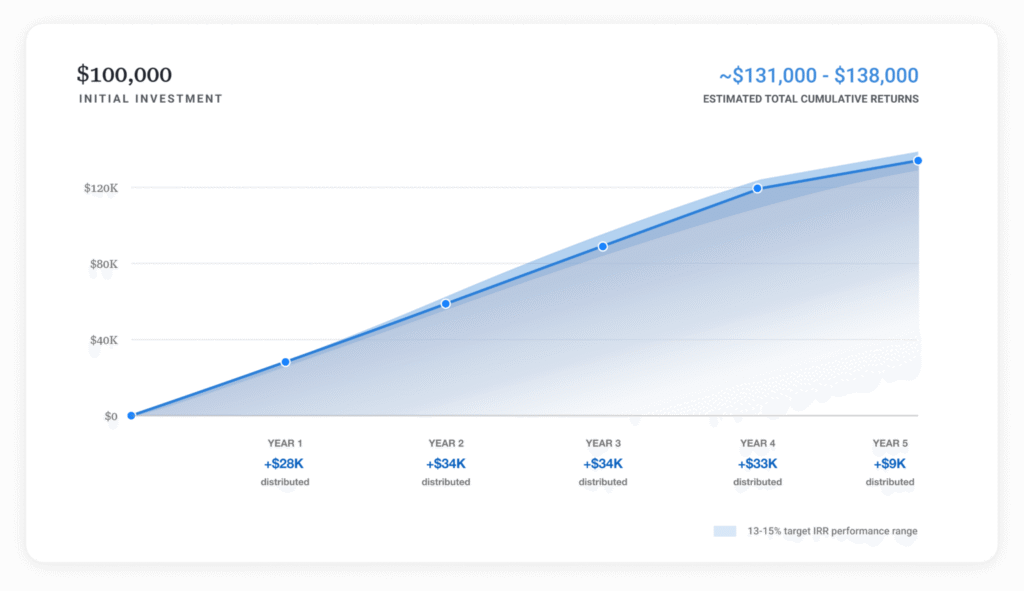
The fund will be open to investors from June 8 – July 10 or until the $1M cap is fully subscribed.
Learn More about the SMB Growth Fund
Benefits Of Private Credit Investing
Private credit investing offers several advantages for income-focused investors.
Higher yield potential >
Private credit investments often provide returns well above traditional savings accounts, CDs, and some bonds. Depending on the structure, yields can fall within the mid to high single-digit range.
Portfolio diversification >
Because private credit returns are tied to lending agreements, they are generally less correlated with public markets. This can help balance a portfolio that is heavily weighted toward stocks.
Defined income and timelines >
Most private credit investments have set terms and predictable income schedules. This makes it easier for investors to plan cash flow and reinvestment strategies.
Risks Of Private Credit Investing
While private credit investing offers benefits, it is important to understand the risks.
Limited liquidity
Investments are typically held for a fixed period. Investors may not be able to access their capital until the term ends. Terms can vary widely, so make sure to review offerings thoroughly.
Credit risk
Borrowers may default on loans. However, asset-backed investments, such as those secured by real estate, can help reduce potential losses. Researching offerings thoroughly, understanding what your capital is backed by, what happens if a borrower defaults, etc. is wise.
Additionally, a diversified approach across multiple investments can help manage these risks.
Private Credit Investing Vs Traditional Fixed Income
Private credit investing differs from traditional fixed income in a few key ways.
Returns are higher than CDs and many bonds. However, liquidity is usually lower due to fixed investment terms. In addition, performance is driven by private lending agreements instead of public market pricing.
For many investors, private credit investing works best as a complement to traditional fixed income rather than a replacement.
Where Private Credit Investing Fits In A Portfolio
Many investors are now allocating a portion of their portfolio to alternatives, including private credit investing. This approach reflects how more diversified portfolios are structured.
A common allocation includes core holdings in stocks and ETFs, growth-focused investments, and a portion dedicated to income-generating alternatives.
Private credit investing can play a role in generating steady income while reducing reliance on public market performance.
How Groundfloor Supports Private Credit Investing
Groundfloor provides access to private credit investing through real estate-backed lending products. These investments are designed to generate consistent income with defined terms.
Within the platform, Notes are positioned as a fixed income alternative. Investors can choose durations that range from short-term to longer-term options, depending on their goals.
> Explore Groundfloor Notes up to 8.25%
This structure allows investors to earn fixed returns backed by real estate without directly owning or managing properties. It also provides transparency into performance and clear timelines for when capital is returned.
For investors looking to add private credit investing to their portfolio, this approach offers a straightforward way to get started.
Private credit investing is becoming an increasingly important part of modern portfolios. As traditional fixed income options deliver lower yields, investors are exploring new ways to generate income and diversify risk.
With higher return potential, defined terms, and broader access, private credit investing offers a practical alternative for those seeking more control over their income strategy.
Learning how to evaluate opportunities and where they fit within a portfolio is key to making informed investment decisions.
FAQs
Private credit investing involves lending money through non-bank platforms in exchange for fixed returns, often backed by assets like real estate.
Private credit investing carries risks, including borrower default and limited liquidity. However, asset-backed investments and diversification can help reduce risk.
Private credit investing typically offers higher returns than bonds, but with lower liquidity and different risk exposure tied to private loans.
Many platforms now offer low minimum investments, making private credit investing accessible to individual investors.
Returns vary depending on the investment, but many private credit opportunities offer higher yields than traditional savings accounts and CDs.