Updated September 8, 2026
Final Close: September 30th, 2026 – Groundfloor expanded its private markets platform with the launch of the Music Royalties Portfolio this year, a new investment opportunity available exclusively to accredited investors. The first opening sold out before closing.
The portfolio targets a 12–15% net internal rate of return (IRR) over a projected one- to four-year hold by investing in a diversified portfolio of music royalty assets that already generate recurring cash flow. Investors earn quarterly cash distributions from ongoing royalty income and may earn additional returns when the portfolio sells.
Rather than investing in a single artist or album, the Music Royalties Portfolio provides diversified exposure across more than 2,000 songs spanning 18 music catalogues. The portfolio includes royalty interests tied to works by well-known artists including Mariah Carey, Dr. Dre, and Eminem, with one holding including an interest in Mariah Carey’s perennial holiday classic, All I Want for Christmas Is You.
Like every Groundfloor offering, we rigorously vet, curate, and structure the portfolio for individual investors, while experienced specialists manage the underlying assets. The result: access to an institutional asset class that has historically been available primarily to specialty finance firms, private funds, and large investment managers.
Invest in the Music Royalties Portfolio Now
Where Your Return Comes From
Great music never stops earning.
Every stream, radio play, television or film placement, advertisement, and public performance generates royalty payments for the rights holders.

The Music Royalties Portfolio transforms recurring royalty cash flows into two complementary sources of return.
- First, investors receive quarterly cash distributions generated by ongoing royalty income while the portfolio owns the underlying music rights.
- Second, the portfolio seeks long-term appreciation by aggregating established music catalogues and ultimately selling them into the institutional marketplace. Together, these two return drivers contribute to the portfolio’s target 12–15% net IRR over the expected one- to four-year investment period.
Rather than relying on the success of a single artist or hoping to discover the next chart-topping hit, the strategy focuses on acquiring music assets that are already generating measurable royalty income.
Watch Part 1 & Part 2 of the Podcast to learn more about what drives returns, how Music Royalties work as an asset class, and more.
How the Strategy Works
The Music Royalties Portfolio provides exposure to a professionally managed portfolio of royalty-producing assets sourced and managed by Pier Asset Management, a Los Angeles-based specialist in niche asset-backed credit.
The strategy focuses on acquiring established music catalogues that already produce recurring royalty income rather than attempting to predict future chart success.
The portfolio targets what the investment team refers to as “right-sized” catalogues, generally valued between approximately $250,000 and $10 million. These assets often occupy an underserved portion of the market—typically too large for individual buyers while remaining too small for many institutional acquisition funds.
By acquiring these seasoned royalty assets, combining them into larger diversified portfolios, and managing them professionally, the strategy seeks to create value before an eventual institutional sale.

The portfolio includes ownership interests across more than 2,000 songs spanning 18 music catalogues, providing broad diversification across artists, genres, and royalty streams. No single song defines the investment’s outcome.
Groundfloor independently evaluated both the asset class and the investment strategy before making the opportunity available to investors.
Why Music Royalties?
The music industry has undergone a structural transformation over the past decade as subscription-based streaming services shifted music consumption from one-time purchases to recurring revenue.
Instead of relying primarily on album sales, today’s royalty ecosystem generates income every time listeners stream a song on platforms such as Spotify, Apple Music, YouTube Music, Amazon Music, and other digital services. Radio broadcasts, television, film, advertising, video games, and other licensing opportunities generate additional royalty income.
Because many established songs continue generating revenue long after their initial release, mature music catalogues can produce recurring cash flows supported by years of historical performance.
This evolution has attracted growing institutional interest. Since 2020, issuers have completed more than $12.9 billion in rated music royalty securitizations, while global streaming continues to expand as subscription adoption grows worldwide.
Why Institutional Investors Have Embraced the Asset Class
Institutional investors are investing because established music rights have become cash-flowing financial assets.
The strategy behind the Music Royalties Portfolio is built around acquiring proven royalty-producing catalogues with demonstrated performance histories. Rather than relying on future popularity, the portfolio focuses on assets that have already established recurring revenue streams.
The investment also seeks to capitalize on a structural inefficiency within the marketplace. Investment managers can often acquire smaller music catalogues directly from rights holders, combine them into larger institutional-quality portfolios, and sell them to sophisticated buyers.
For investors, the result is exposure to an asset class whose return drivers differ meaningfully from traditional stocks, bonds, and many forms of private credit.
Why Groundfloor Is Expanding Beyond Real Estate
Groundfloor has spent more than a decade helping investors access private market investments that were once reserved primarily for institutions.
While the company’s foundation remains real estate-backed investing, the Music Royalties Portfolio reflects Groundfloor’s continued expansion into specialty finance and alternative income-producing assets.
The investment follows the same philosophy behind Groundfloor’s broader platform: identify institutional-quality opportunities, perform rigorous due diligence, structure the investment for individual investors, and provide professional management throughout the life of the investment.
For investors, that means gaining exposure to an asset class that would otherwise require specialized industry relationships and operational expertise.
A Complement to a Diversified Private Market Portfolio
Music royalties occupy a unique position within alternative investments.
Unlike traditional corporate credit or public equities, royalty payments are driven primarily by consumer listening habits and commercial licensing demand rather than corporate earnings or broader financial markets.
For investors building diversified private market portfolios, music royalties may complement allocations to:
- Real estate credit
- Private credit
- Revenue-based financing
- Asset-backed lending
Together, these investments can provide exposure to multiple underlying sources of cash flow and return drivers rather than relying on a single asset class.
Professionally Managed from Investment Through Exit
Following investment, Groundfloor’s Investments team oversees investor administration, distributions, and ongoing portfolio communications while Pier Asset Management manages the underlying music catalogue.
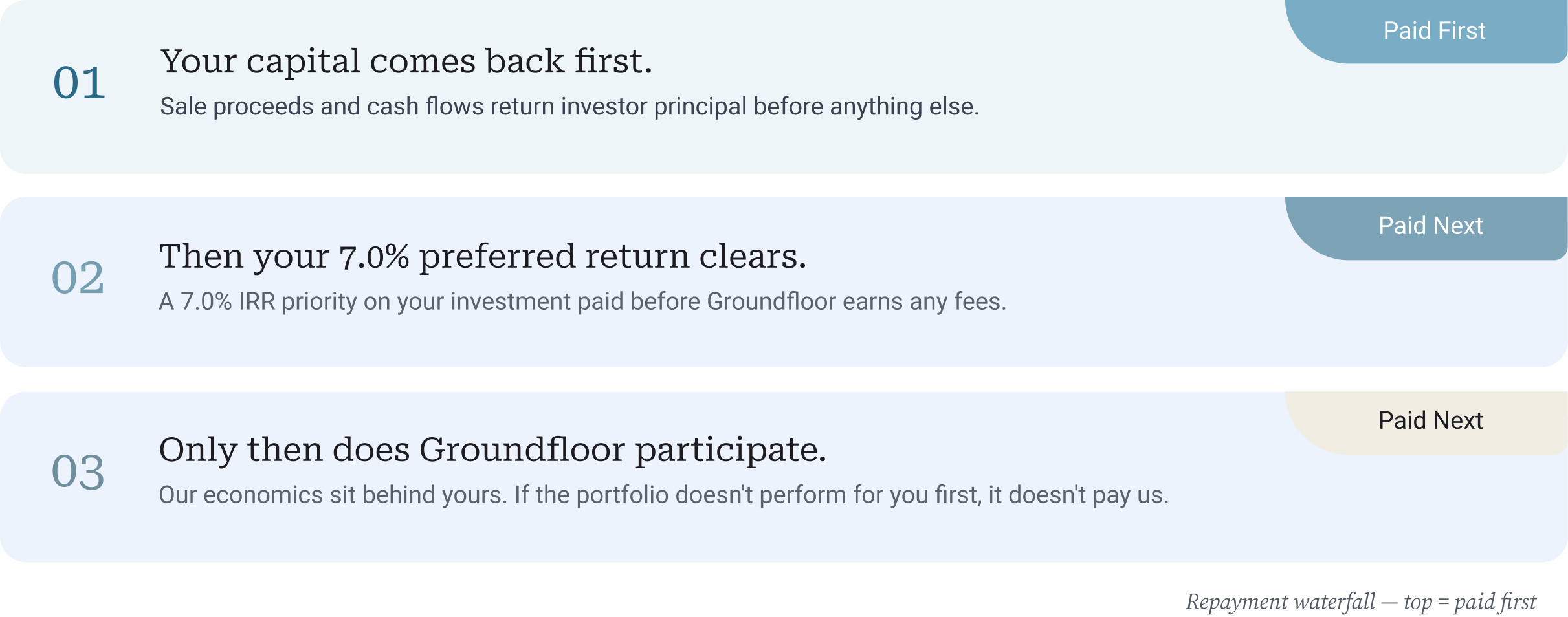
Investors receive quarterly cash distributions as the portfolio collects royalty income, along with straightforward 1099-INT tax reporting instead of more complex partnership tax documentation. The investment gives investors institutional-style exposure without requiring them to source music rights, negotiate acquisitions, or manage royalty administration themselves.
Key Considerations
Like all private market investments, the Music Royalties Portfolio involves investment risk and should be evaluated as part of a diversified portfolio.
Prospective investors should consider that:
- Target returns are objectives and are not guaranteed.
- The investment has an expected holding period of one to four years.
- Quarterly distributions depend on underlying royalty cash flows and may vary.
- Music catalogue values can fluctuate based on market conditions and buyer demand.
- Private investments are generally less liquid than publicly traded securities.
Because bank transfers can take several business days to settle before we allocate funds to an investment, interested investors should confirm their accreditation and initiate funding early.
The Bottom Line
The Music Royalties Portfolio introduces a differentiated specialty finance strategy built around one of today’s fastest-growing institutional alternative asset classes.
By combining diversified royalty income from more than 2,000 songs, quarterly cash distributions, professional portfolio management, and a target 12–15% net IRR, the portfolio provides accredited investors access to an investment opportunity that has historically been available primarily through institutional investment managers.
As Groundfloor continues expanding beyond real estate into broader private market opportunities, the Music Royalties Portfolio reflects the company’s mission of making institutional-quality alternative investments more accessible while continuing to build a diversified platform for long-term investors.
Frequently Asked Questions
What is the Groundfloor Music Royalties Portfolio I?
The Groundfloor Music Royalties Portfolio gives accredited investors access to master and publishing rights across more than 2,000 songs spanning 18 music catalogues. The portfolio targets a 12–15% net IRR through quarterly royalty distributions and potential appreciation when the investment team sells the portfolio over an expected one- to four-year hold.
How do music royalties generate returns?
The portfolio generates returns in two ways.
First, investors receive quarterly cash distributions generated by ongoing royalty income from streaming, radio, television, film, licensing, and other commercial uses.
Second, the portfolio seeks long-term appreciation by acquiring established music catalogues, aggregating them into institutional-quality portfolios, and ultimately selling them into the broader institutional marketplace. Together, these two sources contribute to the portfolio’s target return.
Is this a bet on picking the next hit song?
No. The strategy focuses on established music catalogues with proven royalty histories rather than predicting future chart-topping artists.
Each acquisition includes at least 18 months of historical performance, and the portfolio diversifies investments across more than 2,000 songs and 18 catalogues. The investment thesis focuses on acquiring proven, cash-flowing assets rather than speculating on new releases.
What are the target returns and investment terms?
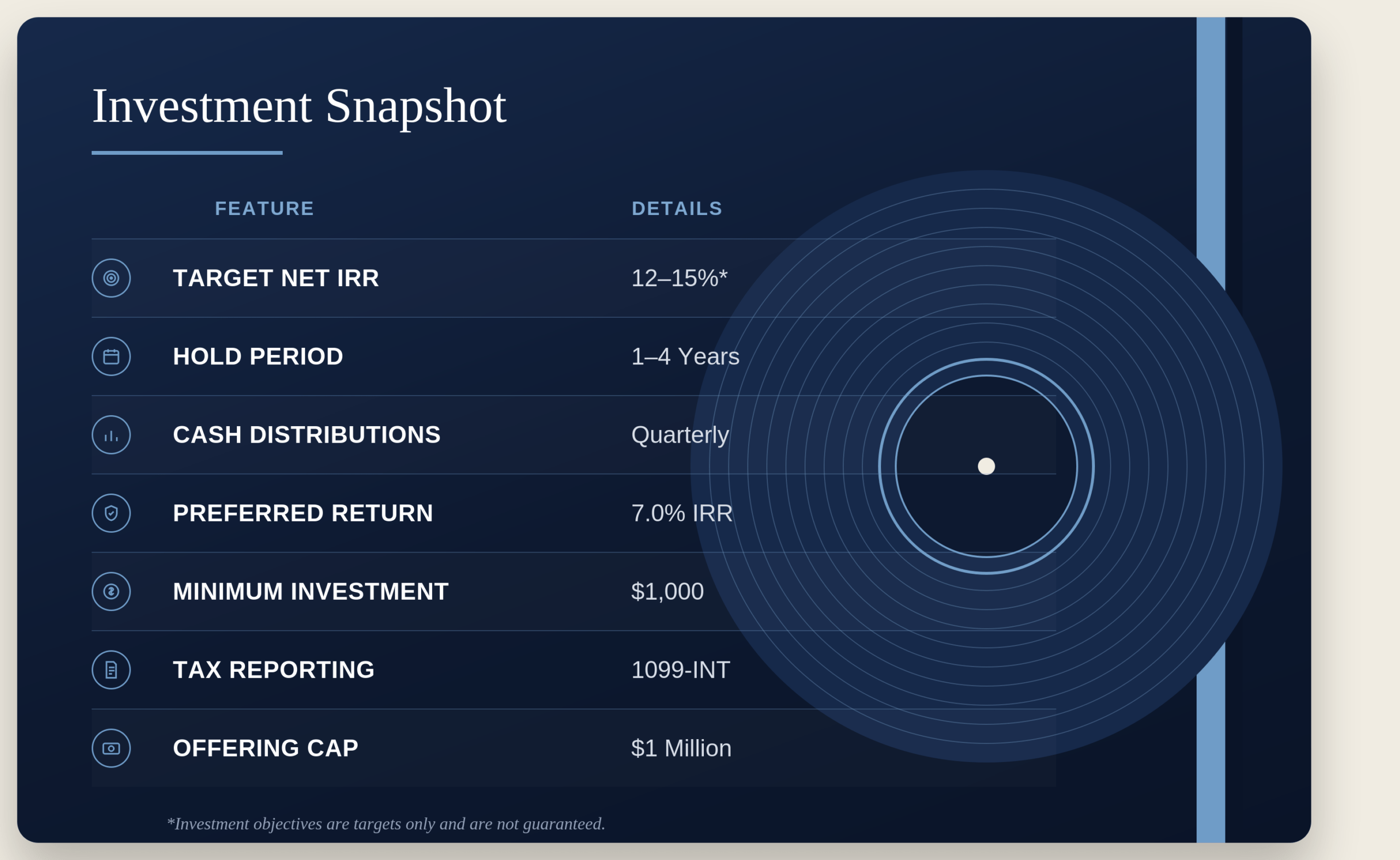
The portfolio targets a 12–15% net IRR over a projected one- to four-year hold. Cash distributions are quarterly throughout the investment period.
Key terms include:
- $1,000 minimum investment
- Quarterly cash distributions
- 7.0% preferred return
- 1099-INT tax reporting
- $1 million offering cap
- Available exclusively to accredited investors under Regulation D
Investment objectives are targets only and are not guaranteed.
Who manages the investment?
Groundfloor oversees the investment from commitment through exit, handling investor administration, distributions, and portfolio oversight. Pier Asset Management, a Los Angeles-based specialist in niche asset-backed credit and music rights investing, manages the underlying music catalogue. Investors commit capital once, while the portfolio managers oversee acquisitions, royalty administration, and the eventual sale of the portfolio.