Own a Piece of Every Play.
2,000+ songs across 18 catalogues — featuring a stake in Mariah Carey’s “All I Want for Christmas Is You” and rights tied to works by Dr. Dre and Eminem.
Songs the world already knows, generating royalties with every play, everywhere.
Great music never stops earning. The 2,000+ songs in this portfolio generate royalties from streaming, radio, sync, and licensing, creating two sources of return: quarterly cash distributions while you hold and potential appreciation when the portfolio sells. That appreciation comes from acquiring master and publishing rights directly from rightsholders and selling seasoned, aggregated catalogues into the institutional securitization market.
The portfolio targets “right-sized” catalogues valued between $250,000 and $10 million, too large for most individual buyers and too small for institutions to acquire efficiently. Our industry partner has historically acquired these assets at 5.0–7.5x trailing-twelve-month revenue, while institutional buyers have paid approximately 10.0–15.0x for seasoned, aggregated portfolios. The opportunity isn’t picking hit songs. It’s executing between two inefficient markets.
Backed by an industry partner, this is the Groundfloor model at work: structuring new avenues for individual investors to access institutional opportunities that are highly vetted and diligently managed from acquisition through exit. It’s the same disciplined approach behind more than $2.2 billion invested across our platform since 2013.
12–15%

The Groundfloor Investor Team

Within the 1–4 year hold, the aggregated catalogue is sold into the institutional securitization market — where seasoned, consolidated assets command 10.0–15.0x revenue. The sale returns your principal plus the appreciation captured in the pricing gap.

STRATEGY A · THE BASE CASE
Sale proceeds and cash flows return investor principal before anything else.
A 7.0% IRR priority on your investment paid before Groundfloor earns any fees.
Our economics sit behind yours. If the portfolio doesn't perform for you first, it doesn't pay us.
Music royalty pricing has two tiers, and the portfolio operates in the gap between them. Individual rightsholders selling mid-size catalogues have few buyers — so acquisitions price low. Institutional securitization funds need seasoned, aggregated assets at scale — so they pay a premium for exactly what this portfolio assembles.
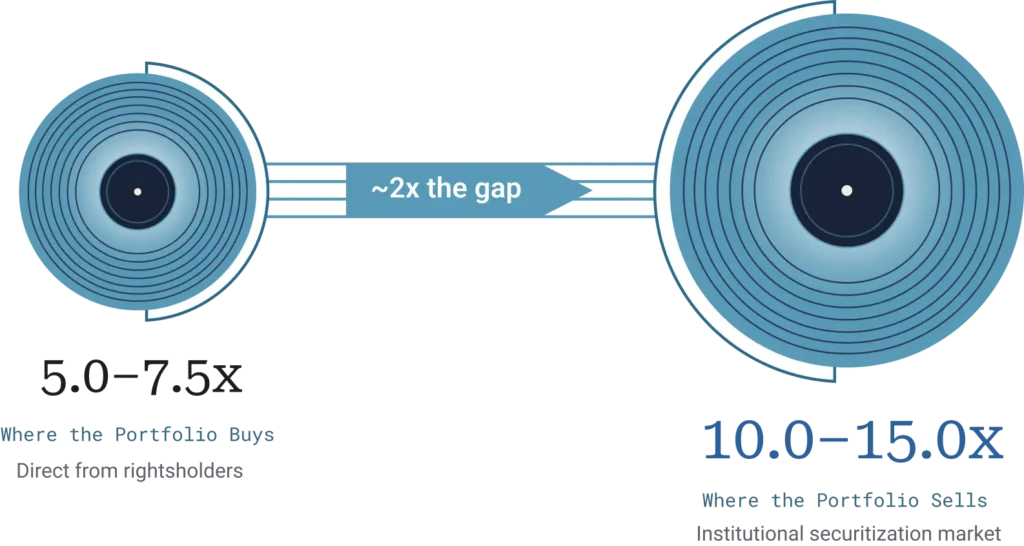
Multiples reflect our industry partner’s acquisition history for right-sized catalogues versus institutional securitization market pricing. Exit pricing is not guaranteed.
Streamed on music platforms and the radio
Performed live by the artist
Downloaded or sold via physical copies
Used in film, TV, ads, and games
Every element of the portfolio — what it buys, who it sells to, and when — is designed in advance. Two design principles, two exit strategies, all working toward the same outcome.
Every element of the portfolio — what it buys, who it sells to, and when — is designed in advance. Two design principles, two exit strategies, all working toward the same outcome.
Hypothetical illustration scaled from Groundfloor's $1M portfolio model — targets only, not guaranteed. Net of the 1% management and 20% performance fees, above a 7% preferred return. Exit multiple and timing are not assured; a soft exit can fall below the target range.
$1,000 minimum in a payment-dependent note issued by a Groundfloor SPV, backed by a pooled investment into Pier’s fund vehicle. It's hands-off from there.
Groundfloor's Investments team oversees your position while our industry partner runs the seasoned catalogue — 2,000+ songs across 18 catalogues, each acquired with 18+ months of performance history to age out early volatility.
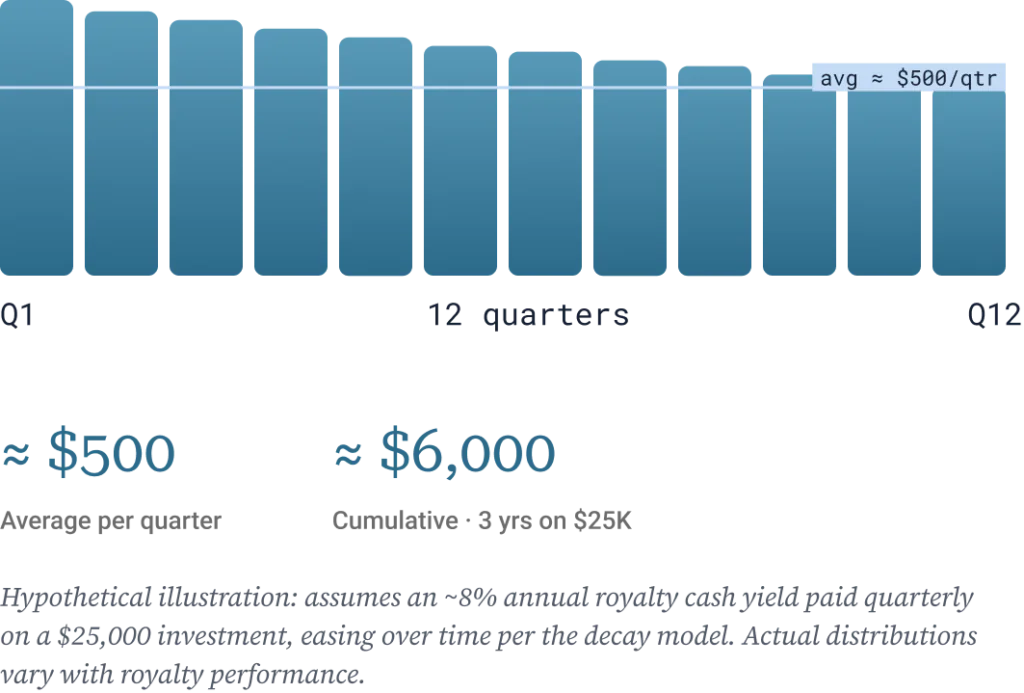
Royalties from streaming, radio, sync, and licensing flow through as quarterly cash distributions. A 7.0% preferred return sets your investment as a priority before Groundfloor earns any fees.
Within the 1–4 year hold, catalogues are sold into the multi-billion-dollar securitization market — where aggregated, seasoned assets command 10.0–15.0x revenue. Sale proceeds return your principal plus appreciation.
Groundfloor doesn’t enter asset classes we can’t rigorously evaluate. Leveraging our decade of underwriting history rooted in real estate credit, we’re collaborating with Pier Asset Management, a leading investment firm in niche private credit, to bring an unprecedented offering that is managed by domain experts to Groundfloor investors.
Headquartered in Los Angeles, the heart of the music industry, Pier has acquired music rights directly from artists, labels, producers, and managers since 2021, and continues to expand their presence in the industry with the launch of Mooring Music Group, a dedicated music rights financing firm, in 2024.
For rights-holders, Pier unlocks liquidity traditionally available only to major catalogues. For institutions, Pier delivers a consolidated pipeline of seasoned, market-ready assets they couldn’t assemble piecemeal. The portfolio sits exactly in the middle — and earns from both sides of that bridge. Royalties are collected primarily from the world’s largest streaming platforms, led by Spotify and Apple Music.

Alts.co Reviewed Groundfloor. Here’s What Stood Out
May 13, 2026

May 13, 2026

Groundfloor Investment Insights Q2 2026
July 14, 2026

July 14, 2026
Groundfloor was the first company qualified by the SEC to offer direct real estate debt investments to all investors. The Music Royalties Portfolio extends the same model — building access to institutional assets for individual investors without compromising on quality and management.
Recognized by the Inc. 5000 six consecutive years and named Best Alternative Investment Platform at the 2025 Benzinga Global Fintech Awards. Past performance is not indicative of future results.
Everything you need to evaluate the portfolio — the strategy, the catalogue, the economics, and the risks. If your question isn’t covered here, our Investor Success team is a message away.
The Groundfloor Music Royalties Portfolio I is an accredited-only investment unlocking credit exposure to a diversified music catalogue. You invest in a payment-dependent note backed by an investment into Pier’s institutional fund made by a Groundfloor SPV.
Two ways. First, ongoing income: every stream, download, radio spin, and sync license generates royalty payments to the rights owner, which flow through to investors as quarterly cash distributions. Second, appreciation at exit: the portfolio acquires catalogues at 5.0–7.5x trailing-twelve-month revenue directly from rightsholders, then sells aggregated, seasoned assets into the institutional securitization market, which pays 10.0–15.0x — a pricing gap that drives the target return.
No, it is deliberately the opposite. The portfolio only acquires catalogues with 18+ months of performance history, and every royalty stream is modeled against a decay curve that assumes popularity declines. The return driver is the measurable pricing gap between two markets, not a prediction about what people will listen to next. Songs that outperform the decay model are upside.
The catalogue is run by Pier Asset Management, a Los Angeles-based investment firm founded in 2017, specializing in niche asset-backed credit with more than $900 million deployed. Pier has acquired master and publishing rights directly from artists, labels, producers, and managers since 2021, and in 2024 established Mooring Music Group as a dedicated spin-out running the music royalties business. Groundfloor independently vetted the partner and the strategy, and investors participate through the Groundfloor-managed Groundfloor Mooring SPV I LLC.
Fully managed, end to end. Groundfloor’s Investments team handles every capital call, deadline, and distribution after you invest — you commit once and receive quarterly distributions. Our industry partner manages the underlying catalogue day to day: acquisitions, royalty administration, and the eventual sale into the securitization market, with Groundfloor overseeing the position throughout.
Two pre-designed paths. Strategy A (Aggregate + Sell): once capital is deployed, the initial exit assessment targets early-to-mid 2027 — an off-take to larger institutional funds and a roughly 12–18 month hold for Groundfloor investors; the medium modeled case at a 12-month hold lands in the 12–15% target range, and a high-multiple sale models well above it. Strategy B (Cash Flow + Sell): if the 2027 assessment favors waiting, a later exit may be pursued for higher multiples by 2030, with modest back-leverage (below 50% LTV) augmenting quarterly cash flows in the meantime. Either way, you receive quarterly distributions until the exit and the exit proceeds after.
Returns are not guaranteed and you may lose principal. Royalty income can decline faster than the decay model projects, exit pricing into the securitization market is not assured, and SPV interests are illiquid — you should expect to hold through the full term. Diversification across 2,000+ songs and 18 catalogues reduces the impact of any single asset underperforming, but it does not eliminate risk. Review the full offering documents before investing.
Royalty income has historically remained stable across market environments. For investors whose private market exposure is concentrated in real assets, music royalties add an income stream with genuinely different return drivers.
2,000+ songs are already generating royalties. Our last accredited private market offering filled in under two days. A 12–15% target net IRR*, paid quarterly, open now with a close on September 30th.
12–15%
Target net IRR*
Accredited
Investors only
$1M Cap
Accredited – Reg D
Offering closes

The Groundfloor Music Royalties Portfolio I is offered exclusively to U.S. accredited investors under Regulation D and held in Groundfloor Mooring SPV I LLC. Interests are illiquid and involve risk of loss. Past performance is not indicative of future results.
Offering window September 30th, 2026, or earlier when fully subscribed. Read the full offering documents before investing. © 2026 Groundfloor Finance Inc.