Emerging Alternatives · Reg D · Accredited Only
Pre-IPO investing has two sides. Most investors only see the expensive one — buying the shares. Institutions work the other: lending to the shareholders, secured by the stock, paid in compounding interest and a share of the gain at exit.
Read this first. A 3-6 year commitment with no early redemption; you hold a note from our SPV, not shares in any company. $1 million hard cap, first come, first served — first close October 31, or sooner once it fills.
Target net IRR*
15-18%
Distributions
Quarterly
Minimum to invest
$10k
Term
Preferred return · paid to you first
5.0%
Collateral coverage per position
2-3x
Read this first. A five- to seven-year commitment with no early redemption; you hold a note from our SPV, not shares in any company. $1 million hard cap, first come, first served — first close October 31, or sooner once it fills.
01 · The access
Pre-IPO investing has two sides. Most investors only see the expensive one — buying the shares. Institutions work the other: lending to the shareholders, secured by the stock, paid in compounding interest and a share of the gain at exit.
02 · The investment
From a universe of more than 1,000 private companies valued above $1 billion, Serengeti selects 25 — each screened on fundraising stage, IPO likelihood, secondary-market activity and business-model viability. Current targets include Stripe, Databricks and Anduril. The median holding is a Series E company valued at approximately $24 billion.
03 · How it works
Serengeti advances roughly a third of a shareholder’s stock value and holds all of it in a bankruptcy-remote trust: 2–3× coverage, a 50–66% buffer against loss. 10% PIK interest compounds quarterly against that collateral, and at exit — IPO, acquisition, tender or new round — the loan is repaid with an uncapped stock fee on the appreciation.
04 · The earnings
High-yield potential with a credit-like floor: a base case even if valuations stay flat, uncapped upside if they rise. Quarterly distributions begin after a two-year recycling phase, with stock fee proceeds as exits land. Your return comes first: a 5.0% preferred return is paid to investors before Groundfloor participates.
A $1 million target raise, first come, first served. First close October 31 — Previous Emerging Alternatives have fully subscribed before closing.
As companies stay private longer, the IPO market faces two countervailing forces: a growing backlog of IPO-ready companies, and valuation multiples compressed by growth equity and secondaries already pricing in upside. The backlog means exits are coming. The compression means the next cycle won’t deliver the step-ups of the past decade. Late equity buyers pay for upside already priced in. A lender does not.
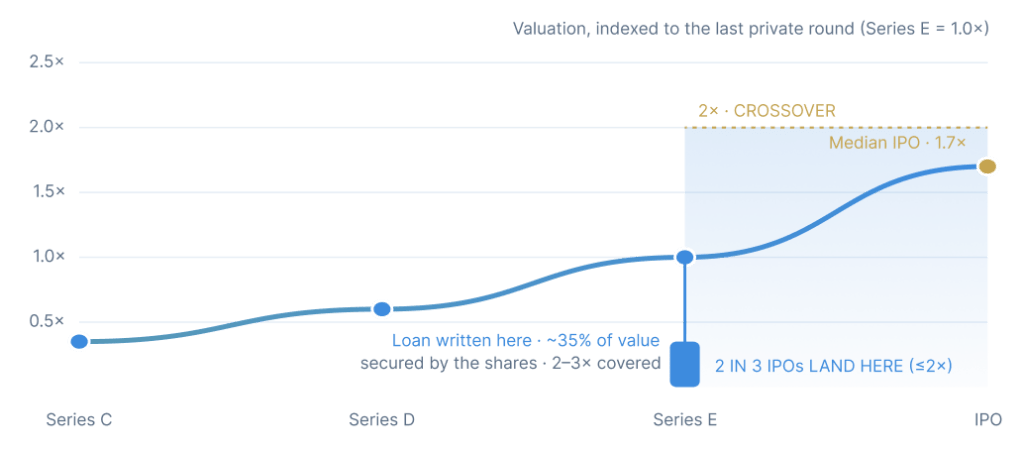
Illustrative, not a specific company. Median IPO step-up of ~1.7× and the two-in-three figure are from our partner’s public commentary and third-party data. The financing is secured against the last-round value, so the loan is covered even if the IPO prices below it.
Why shareholders come to a lender
The financing unlocks liquidity for employees and early investors — to exercise stock options, or to access value locked in private shares without selling.
What the structure is built to do
Generate a credit-like base case even if portfolio companies’ valuations stay flat, and preserve uncapped participation if they appreciate.
01 · The Pipeline
1,000+ Private companies worth more than $1B
02 · The step-up is priced in
1.7x Median IPO vs. the last private round
03 · Selectivity
25 Companies, underwritten from the thousand
Screened on fundraising stage, IPO likelihood, secondary-market activity and business-model viability. Twenty-five names, so no single exit decides your outcome.
Median stage
Beyond the Stock Market · Episode 5
02
03
04
05
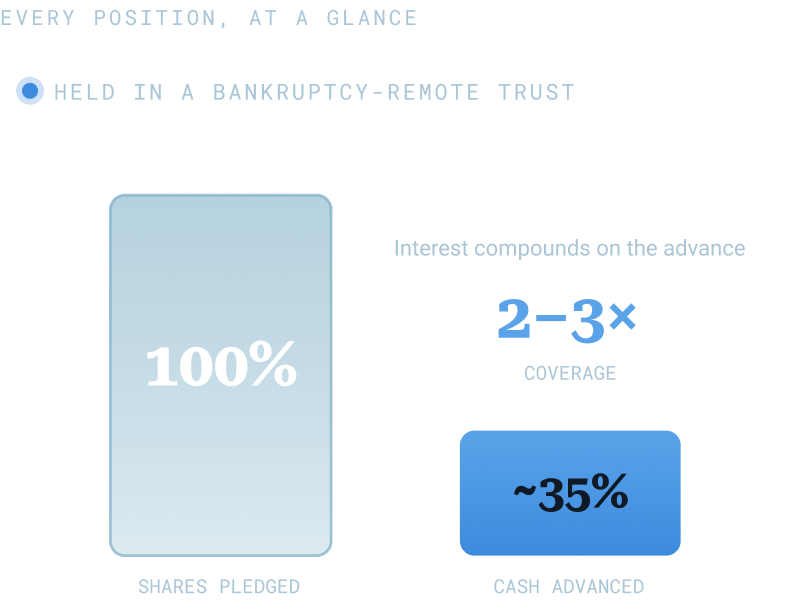
Employees and early investors at the most valuable private companies hold shares they cannot sell. Rather than buying those shares, the portfolio finances the people who own them: cash is advanced against the stock, the stock is pledged as collateral, and the position is held until the company exits.
Structurally it resembles a home-equity loan — the borrower keeps the asset, the lender holds a claim on it, the advance is a fraction of its value. The asset is a stake in a company, and the lender is also paid a share of the gain when it exits.
01
Advance
02
03
Interest
04
Exit
They get liquidity without selling or giving up their upside. The gap between what goes out and what’s pledged is your cushion.
32–40% of as-converted value, paid in cash.
Two to three times collateral behind every dollar, and a 5.0% preferred return paid to you first.
The allocation is limited — first close October 31.
Pick a commitment to see an estimated earnings range across typical exit outcomes. Then drag the exit slider to test a single outcome.
Your commitment
$10,000 minimum · $1,000 increments
At your selected exit
1.0× exitStock finance returns $15,000 more.
Estimated earnings range
For company exits at 1–2× the last private round.
Gains above your $25,000 commitment.
Net return multiples include your original capital. Model assumes a three-year exit.
Illustrative net multiple of invested capital, from our partner’s illustration of a single financing: 35% advance against last-round value, 12% PIK, 12% stock fee, and a three-year hold, net of fund-level fees. Groundfloor’s participation sits behind your 5.0% preferred return.
“Owning the shares” is a direct purchase at the last-round price, sold at exit. The earnings ranges compare modeled gains at 1.0×–2.0× company exits; they do not change with the selected exit slider. Below a 50% decline, outcomes are not modeled.
Illustrative only — not a projection, quote or guarantee. Actual results will differ and you may lose principal.
Return projections · three scenarios
Our partner's portfolio-level projections of net distributions under three sets of assumptions, scaled to your amount. The base case is consistent with the 15–18% target net IRR and the 1.66× target net multiple; the downside falls below target. Scenarios are assumptions, not forecasts or guarantees; the timing of exits is uncertain and you may lose principal.
Stock finance is not sold to individuals. The funds that run it are built for endowments, pensions and family offices, and typically ask $250,000 or more — often seven figures. Groundfloor took one limited-partner seat, divided it into flexible $1,000 units, and handles every capital call, deadline and distribution for you. The same seat at a fraction of the entry; our fee sits on the fund’s, so the same opportunity, not identical returns.
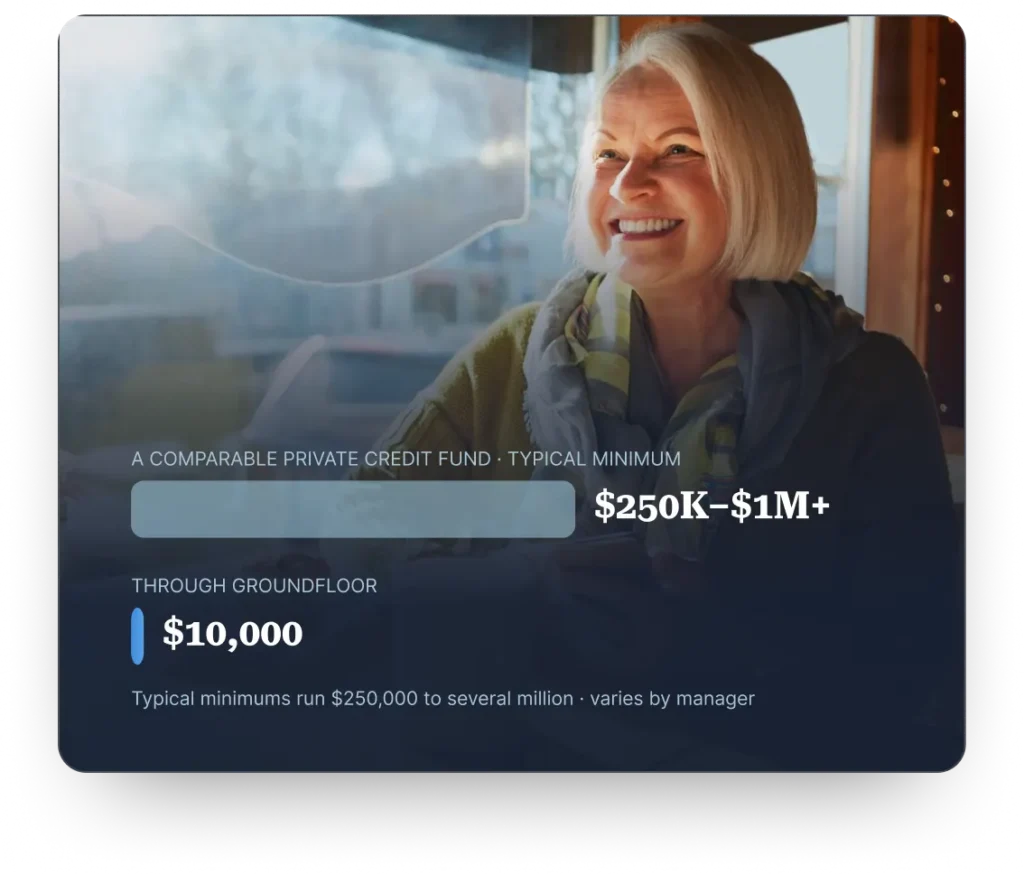
MINIMUM
Capital calls
Tax reporting
What you hold
Your capital comes back
Then Groundfloor participates
$1 million, in $1,000 units. First come, first served — commit early to secure your place before the first close on October 31.
Where the target sits
Here is what the income side of the market pays today, and where a 15–18% target sits — the high-yield potential of lending where institutions lend. The gap is the point: you are paid as a lender and as a participant in the gain, for capital you commit for years.

Paid as a lender
Paid as an owner
Sources: 10-year Treasury 4.83%, Forbes Advisor, Sept 9, 2026 · ICE BofA US High Yield Index effective yield 7.22%, FRED, Sept 8, 2026 · Cliffwater Direct Lending Index 22-year average 9.5%, Aug 19, 2026. Yields, a historical average and a target are different measures and are not directly comparable; the 15–18% is a target only, net of fees, not guaranteed, and reflects a multi-year illiquid commitment with risk of loss.
The partnership
Every Groundfloor offering is built the same way: a specialist manager with a record in its market, and a platform that underwrites the manager before opening the door. Serengeti brings the strategy and the underwriting. Groundfloor brings the access, the structure and the white glove investor experience.
A New York investment firm founded in 2007, specializing in private credit, structured equity and stock finance for late-stage private companies. Serengeti manages approximately $1.5 billion for institutional investors — pensions, endowments and family offices — and has run its stock finance strategy since 2018, with independent fund administration, audit and counsel behind it.

Limited space for accredited investors at Groundfloor.
Commitments are filled in the order they arrive — first close October 31, or earlier once subscribed.
Illustrative only — a map of where the strategy sits, not a projection, and not a recommended allocation.
Limited allocation.
If it fits your growth sleeve, a commitment today secures your place before the first close on October 31.
Is this for you?
Alternatives earn their place by doing what stocks and bonds don’t. Stock finance adds a return driver most portfolios lack — private-company exits, secured by the shares, paid in compounding interest and a share of the upside — with a credit-like floor beneath it.
Private-company exits, secured by the shares — a source of return that doesn’t move with the index.
A 15–18% net target built on compounding interest first and equity upside second, with 2–3× collateral on every position.
Twenty-five underwritten companies, one commitment, fully managed — and a structure that beats owning the shares in every outcome but one.
The Signature Note pays a fixed 8.5% monthly over 12 months, from $1,000 — this portfolio distributes quarterly from year two.
This section is a general overview of where the portfolio may sit within a diversified allocation. It is not investment, tax or legal advice and not a recommendation for any individual. Whether it is suitable for you depends on your own objectives, time horizon and circumstances; consult your own advisers and read the offering documents before investing.
TODAY
No — and it's the most important thing to understand. The portfolio finances the people who already own the shares. Cash is advanced to an employee or early shareholder against their stock, and that stock is held as collateral until the company exits. You hold a payment-dependent note issued by Groundfloor–Serengeti SPV LLC, not shares and not fund units.
Two places. PIK interest of 10–12% accrues and compounds quarterly against the collateral. At exit, a stock fee — targeted at roughly a third of the amount advanced, and uncapped — is settled from the shares. The target is 15–18% net IRR and about a 1.66× net multiple, after fees at both the fund and Groundfloor level, over a five- to seven-year term. Targets are targets and are not guaranteed.
Because only about 40% of the shares' last-round value is advanced, every position is covered two to three times over. The stock can fall by half and the loan remains secured while interest keeps compounding, and the shares sit in a trust that nobody can sell or re-pledge in the meantime. A steeper decline than that tests coverage; no structure removes the risk of loss entirely.
When a company gains more than about 125%. Past that, the interest and stock fee cost more than the protection was worth. Every outcome below it favors this structure — and over the past decade six in ten technology IPOs stepped up 2× or less from their last private round, with the 2025 cohort's median below it. That's the trade: part of the tail, in exchange for a floor and a coupon. Doubles and triples, not home runs.
Two fee layers: the underlying fund's management fee and carried interest, then Groundfloor's participation — behind a 5.0% preferred return to you. The full schedule is in the offering documents. You receive a 1099-INT, not a K-1 — no partnership return, no state nexus, no April delay. Nothing here is tax advice.
Returns are not guaranteed and you may lose principal. A company can fall far enough to test coverage; exits can take longer than modeled; the note is non-transferable. Twenty-five companies is diversification, not immunity. It suits an accredited investor building a growth sleeve who can commit capital for five to seven years. If you need monthly income now, Groundfloor Notes are the better fit — the Signature Note pays a fixed 8.5% monthly from $1,000 — and we'll say so.
Every term is in the offering documents.
Review them, then commit before the first close on October 31 — allocations fill in the order commitments arrive.